
Written by: Jeff Mikos
Reading time: 6 minutes
Updated: 09/30/2026
Published: 04/30/2026
Co-Authored with Algolia
“Delivering successful B2B ecommerce experiences requires both the right technology and the expertise to implement it effectively. McFadyen Digital’s deep subject matter expertise ensures solutions are aligned to real buyer journeys. As a certified Algolia partner, they play a key role in helping customers drive measurable value.”- Matthew Eisnor, Head of Global Alliances
B2B commerce is entering a new era—one where product discovery is no longer just about search, but about enabling faster, more informed buying decisions.
For organizations managing complex catalogs, multiple buyer roles, and intricate purchasing workflows, this shift represents a significant opportunity. AI-driven product discovery is helping B2B enterprises transform how customers interact with their digital storefronts—making discovery more intuitive, contextual, and outcome-driven.
At McFadyen Digital, we’re seeing this evolution firsthand as enterprises modernize their commerce platforms and reimagine the buyer experience.
A New Standard for B2B Product Discovery
B2B environments are inherently complex. If you’re running a B2B commerce operation, you already know the deal—but it’s worth unpacking just how layered this complexity really is:
- Large, attribute-heavy product catalogs
We’re not talking about a few hundred SKUs. Many B2B organizations manage tens (or hundreds) of thousands of products, each with dozens—or even hundreds—of attributes. Think dimensions, materials, compliance standards, compatibility specs. Without intelligent structuring and surfacing of this data, buyers are left navigating a maze instead of a storefront. - Industry specific pricing and assortments
Unlike B2C, where pricing is generally universal, B2B thrives on negotiated contracts. Two customers could be looking at the same product and see entirely different pricing, availability, or even product visibility. This adds a layer of complexity that traditional ecommerce systems weren’t originally designed to handle gracefully. - Multiple stakeholders with different goals
A single purchase might involve an engineer validating specs, a procurement manager optimizing cost, and an operations lead ensuring availability. Each persona approaches the same catalog with a different lens—meaning your ecommerce experience has to flex accordingly, not force a one-size-fits-all journey. - Industry-specific constraints and compliance requirements
Whether it’s FDA regulations, ISO standards, or environmental compliance, B2B buyers aren’t just choosing products—they’re managing risk. Discovery experiences need to surface not just “what fits,” but “what’s allowed,” “what’s certified,” and “what won’t cause a problem six months down the line.”
Rather than simplifying this complexity, leading organizations are leveraging AI to navigate and operationalize it more effectively.
Modern commerce platforms—whether built on BigCommerce, commercetools, Adobe or other architectures—are increasingly integrating AI capabilities to enhance how products are discovered and evaluated.
Evolving Beyond Traditional Search
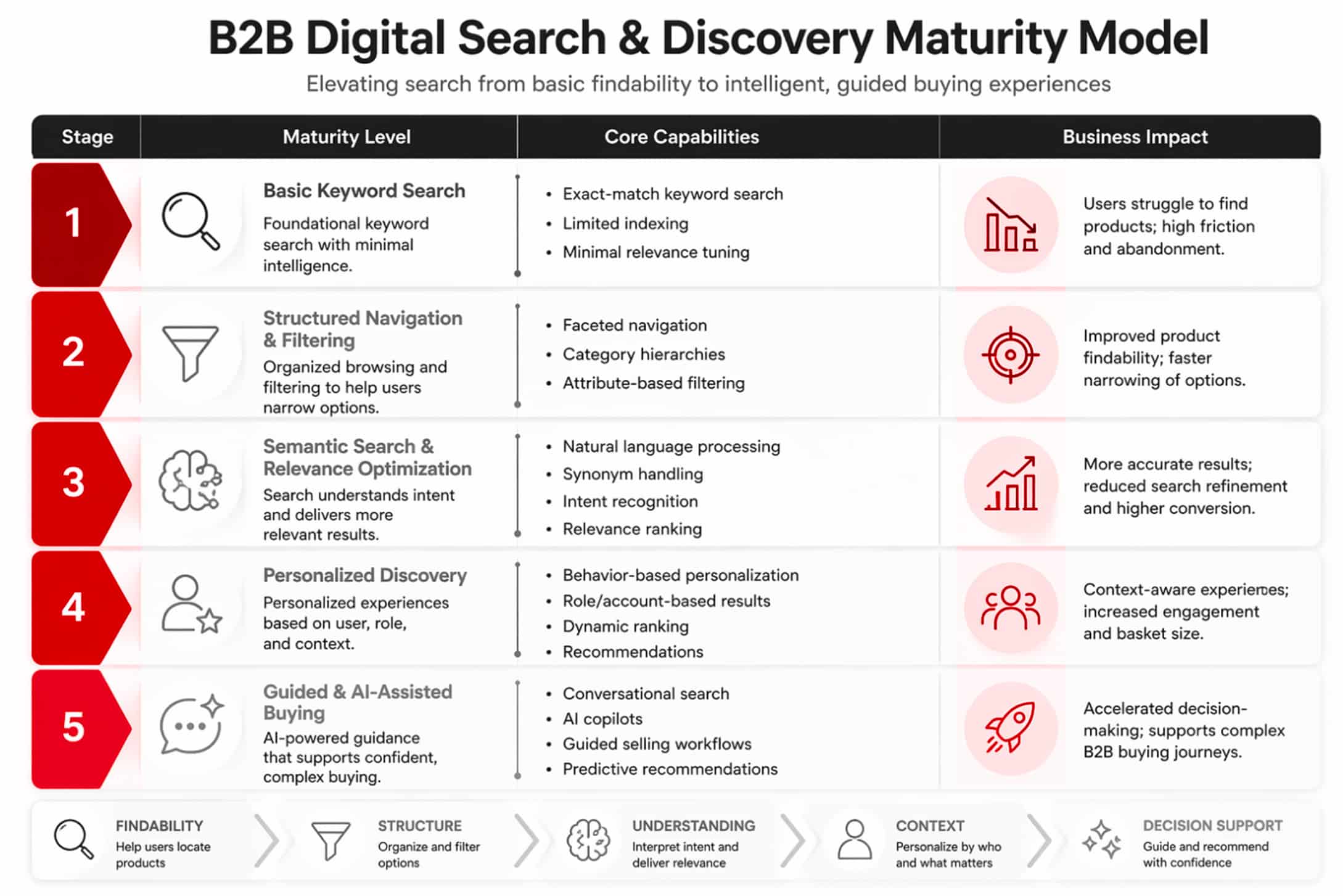
Keyword search and static navigation have long been the backbone of digital commerce. Today, AI is elevating these foundations into more adaptive and intelligent systems.
In modern B2B implementations, we’re seeing:
Hybrid search architectures combining keyword and vector-based search
- Keyword search still plays a role, especially for known-item lookups. But vector-based (semantic) search brings meaning into the equation. Together, they create a hybrid model that understands both exact matches and contextual intent—giving buyers the best of both worlds.
Context-aware ranking driven by user behavior and account data
- Not all results should be ranked equally. AI can prioritize products based on what similar users selected, what the current account typically orders, or even what’s most relevant to a user’s role. The result is a ranking system that feels less generic—and more like it “gets” the user.
Dynamic merchandising that adapts in real time
- Static category pages are giving way to dynamic experiences. AI can adjust product placements based on demand, availability, user behavior, or business priorities. That means your digital storefront is no longer frozen—it’s responsive, adaptive, and (finally) a bit smarter than a spreadsheet.
This evolution enables discovery experiences that align more closely with how B2B buyers think—focusing on outcomes rather than just product attributes.
How AI Enhances B2B Discovery
AI introduces a layer of intelligence that transforms discovery from a static interaction into a guided journey.
1. Semantic Search: Aligning Results with Intent
AI-powered search leverages natural language processing to interpret buyer intent.
For example:
“corrosion-resistant pump for chemical processing”
Instead of returning keyword matches, modern systems:
- Identify material compatibility requirements
- Consider industry-specific constraints
- Surface products aligned with the intended application
In enterprise implementations, this is often enabled through integrations with search platforms like Algolia, combined with custom tuning and domain-specific data models.
2. Personalized Experiences: Context at the Core
In B2B commerce, personalization goes beyond preferences—it’s about business context. In fact, Algolia intelligent personalization responds to user’s live signals in near real time, surfacing the right products as buyer intent evolves.
AI enables platforms to dynamically tailor experiences based on:
- Customer account and contract terms
- Industry and segment
- User role (engineer, procurement, operations)
- Historical purchasing behavior
For example, within the ecommerce environment, this can be implemented through:
- Customer-specific catalogs
- AI-driven ranking and recommendations
- Integration with CRM and ERP systems
The result is a more relevant and efficient buying journey.
3. Intelligent Recommendations: Driving Order Value and Accuracy
AI-powered recommendations in B2B ecommerce are less about driving clicks and more about enabling smarter, more accurate decisions. Rather than simply suggesting popular items, these systems are designed to understand the context of a buyer’s needs and surface products that truly add value to the purchase. This can include compatible components and spare parts that ensure operational continuity, complementary products and bundles that complete a solution, and contract-preferred or frequently reordered items that align with established purchasing patterns. They can also recommend suitable substitutes when products are unavailable or when compliance requirements come into play. When thoughtfully integrated into the overall commerce experience, these recommendations not only enhance relevance but also play a meaningful role in increasing average order value (AOV) while improving order accuracy—reducing the likelihood of errors that can slow down operations or create additional costs.
4. Guided Selling: Bridging Discovery and Decision-Making
For complex product categories, guided selling is quickly becoming an essential part of the B2B ecommerce experience. When buyers are faced with highly technical options, layered specifications, and significant downstream impact, simply presenting a list of products isn’t enough. AI-driven guided selling introduces a more intuitive, consultative approach—one that mirrors the experience of working with a knowledgeable sales expert. Instead of expecting users to know exactly what they’re looking for, these systems engage buyers with contextual questions, helping clarify needs and uncover requirements that may not have been explicitly stated.
As the interaction progresses, AI works behind the scenes to narrow down options, filtering out irrelevant products and surfacing those that best align with the buyer’s specific use case. The end goal isn’t just to present choices, but to recommend optimal product configurations that meet both technical and business requirements. This is especially important in B2B environments, where selecting the wrong product can lead to operational inefficiencies, compliance issues, or costly rework.
In practice, effective guided selling experiences are rarely powered by AI alone. They typically combine rules-based logic—capturing known constraints and business rules—with machine learning models that adapt to user behavior and evolving patterns. Layered on top of this is domain expertise, which ensures that recommendations are grounded in real-world application and industry knowledge. This blend of logic, intelligence, and expertise creates a scalable digital advisor that can support buyers at any stage of their journey.
The value of this approach is particularly evident in industries such as manufacturing, distribution, and healthcare, where product decisions carry significant operational weight. In these contexts, guided selling doesn’t just simplify discovery—it reduces risk, increases confidence, and ultimately helps organizations make better, faster decisions.
A Real-World Scenario
Consider a buyer searching for:
“Valve for high-pressure steam system”
In a modern AI-enabled commerce environment:
- The query is interpreted for pressure, temperature, and use case
- Only suitable and compliant products are surfaced
- The system recommends:
- Compatible fittings
- Maintenance kits
- Results are tailored based on:
- Customer-specific pricing
- Past purchasing patterns
This type of experience is increasingly achievable through well-architected commerce ecosystems that integrate AI across search, recommendations, and data layers.
Business Impact for B2B Enterprises
Organizations that invest in AI-driven discovery are seeing tangible benefits:
- Improved conversion rates through more relevant results.
When buyers find what they need faster—and with more confidence—they’re far more likely to complete the purchase. - Increased AOV via intelligent cross-sell and upsell
Intelligent recommendations surface higher-value combinations and complementary products that buyers might not have considered.
- Reduced reliance on sales teams for routine transactions
AI-powered discovery handles the “easy” transactions, freeing sales teams to focus on high-value, complex deals.
- Faster purchasing cycles
Less searching, fewer errors, and more confidence mean buyers move from discovery to checkout more quickly.
- Enhanced customer satisfaction and retention
A smoother, smarter buying experience builds trust—and in B2B, trust tends to translate into long-term relationships.
For many enterprises, this becomes a key differentiator in competitive digital channels.
The Future of B2B Product Discovery
As AI capabilities continue to evolve, B2B commerce is moving toward:
- Conversational and AI-assisted buying experiences
- Proactive, intent-driven product recommendations
- Deeper integration between commerce, CRM, and supply chain systems
- Increasing automation in procurement workflows
The focus is shifting from enabling transactions to enabling outcomes.
Getting Started
For organizations beginning this journey, a phased approach is often most effective:
- Strengthen product data and PIM capabilities
- Implement semantic or hybrid search
- Introduce AI-driven recommendations
- Enhance complex categories with guided selling
- Continuously optimize using analytics and user behavior
Final Thoughts
AI-driven product discovery represents a significant opportunity for B2B organizations to elevate their digital commerce experiences. By combining the right data foundation, technology stack, and implementation strategy, businesses can create discovery journeys that are not only efficient—but truly intelligent.
At its core, this transformation is about helping buyers make better decisions—faster, and with greater confidence. At McFadyen Digital, we’re here to help guide you through each phase of the journey and develop solutions that propel your B2B organization into the next era of product discovery.
About Algolia
Algolia moves B2B organizations beyond traditional search towards intelligent information retrieval.
From search to gen AI to agentic services, Algolia gives teams a single AI-powered retrieval platform for building fast, intuitive, and adaptive buying experiences. Algolia helps reduce friction across complex catalogs and guides buyers toward better decisions with less effort. It is the practical foundation for turning digital commerce from a product search into an intelligent buying journey.
Related Articles


Turn Insight Into Impact.
Start Today.