Written by: Jeff Mikos
Reading time: 6 minutes
Updated: 03/19/2026
Published: 03/19/2026
Buying the suite is not the same as activating it.
Most organizations running Adobe Commerce today have access to a sophisticated layer of AI-driven commerce capability and have never turned most of it on. This is not a vendor problem or a technology gap. It is a platform activation problem, and it is far more common than it should be.
The business case for AI-driven personalization is settled. The gap is implementation depth. Teams replatform, go live, and move on to the next initiative. The AI capabilities sit dormant, waiting for a second phase that rarely arrives on schedule. Industry research consistently puts enterprise martech utilization at less than 50%, and commerce platforms often follow the same pattern.
Here is a practitioner’s read on what Adobe Commerce actually has under the hood, where most implementations fall short, and what that means for the teams heading into Adobe Summit with big ambitions and an under-configured stack.
Live Search and Intelligent Merchandising: The Data Plumbing Problem
Adobe Live Search is not a UI upgrade. It is a SaaS-based, AI-powered search replacement that fully displaces the default OpenSearch or Elasticsearch engine. It moves native search away from exact-match limitations and introduces intelligent, behavioral-based discovery.
So why do teams activate it and then complain that it never got smarter? Because they skip the data plumbing.
Live Search relies on a continuous optimization loop driven by aggregated visitor behavior and catalog data. Out-of-the-box templates like Luma handle data collection natively. Modern headless storefronts do not. They require manual event configuration and a storefront events collector. If the storefront is not emitting the right behavioral signals, the AI has nothing to learn from.
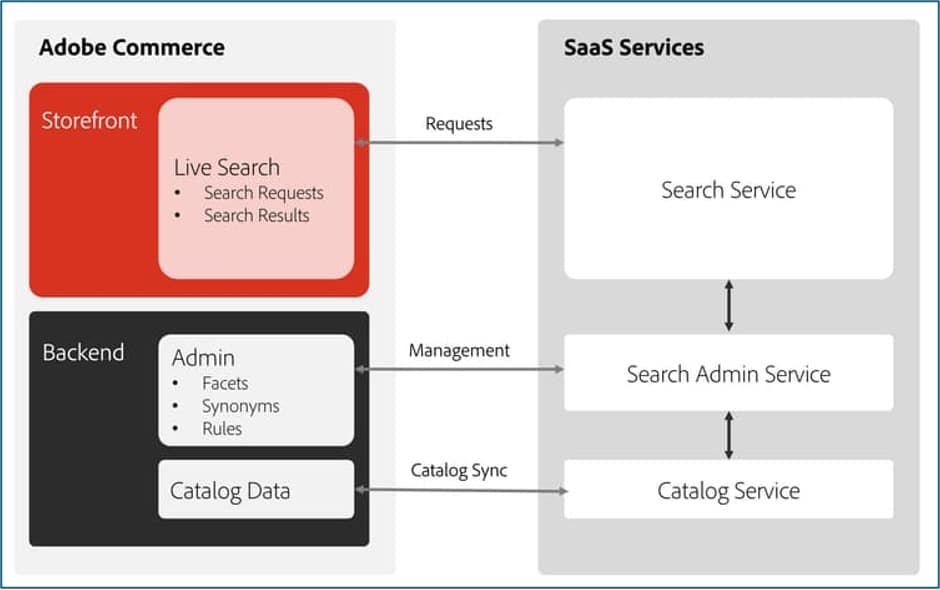
There is also the matter of the Intelligent Category Merchandising layer, which most administrators ignore entirely. This feature allows you to re-rank category pages dynamically using AI algorithms tuned to trending behavior, purchase history, and individual relevance signals. When instrumented correctly, the conversion lift is material. The feature is included. Most teams never touch it.
When instrumented correctly, the conversion lift is material. Organizations that fully activate Live Search with Intelligent Merchandising typically see measurable gains across three dimensions:
- Conversion rates improve because behavioral relevance replaces static exact-match logic
- Average order value increases because AI-ranked categories surface trending and high-margin products at the right moment
- Merchandising overhead drops because the platform handles re-ranking dynamically rather than requiring constant manual rules.
The feature is included, yet most teams never touch it.
Product Recommendations: Deployment Depth Matters
Adobe Commerce includes 13 distinct recommendation types natively, including Visual Similarity modules that recommend products based on appearance. This is a meaningful “sell more of what the shopper actually wants” lever, and most implementations use a fraction of it.
The failure mode is consistent. An implementation team places a single recommendation widget on the homepage, checks the box, and moves on. Real activation means instrumenting a continuous merchandising layer across product detail pages, carts, category pages, and post-purchase flows.
Teams also routinely underestimate the cold-start problem. Behavioral models require time and volume to train. Broken event collection on headless builds, particularly missing view, add-to-cart, and purchase events, causes recommendation quality to stall. The symptom looks like bad AI. The root cause is bad instrumentation.
There is also an organizational question here. Recommendation quality is not a set-and-forget outcome. It requires a named owner, usually a digital merchandiser or ecommerce operations manager, who monitors model performance, audits event collection, and iterates on placement strategy. In most new post-go-live org structures, that owner may not exist.
Real-Time CDP: The Closed Loop Most Teams Never Close
Adobe’s Data Connection extension is designed to ship commerce behavioral, back-office, and customer profile data directly into the Adobe Experience Platform. This is the architecture for building a unified profile that understands what an account does across channels and time, moving well beyond a single storefront session.
Adobe Commerce’s Data Connection extension handles this natively for Adobe Experience Platform customers. Organizations running a third-party CDP — Segment (Twilio), Salesforce Data 360 (formerly Salesforce Data Cloud), or others — can achieve the same architecture, but the integration requires custom connectors rather than out-of-the-box configuration. The principle holds regardless of vendor. The effort does not.
The most underutilized capability in this ecosystem is the return path. Development teams successfully push commerce data into the Real-Time CDP and stop there. They fail to activate those audiences back into the storefront. The CDP becomes an expensive segmentation warehouse rather than a real-time experience engine.
Closing the loop requires rigorous identity resolution and governance so that segments built on browsing behavior, past purchases, or churn propensity are actually consumed by the Commerce storefront or tools like Journey Optimizer. Without that return path, the investment in data integration produces reporting. It does not produce experience.
Edge Delivery and Experimentation: Speed as a Personalization Strategy
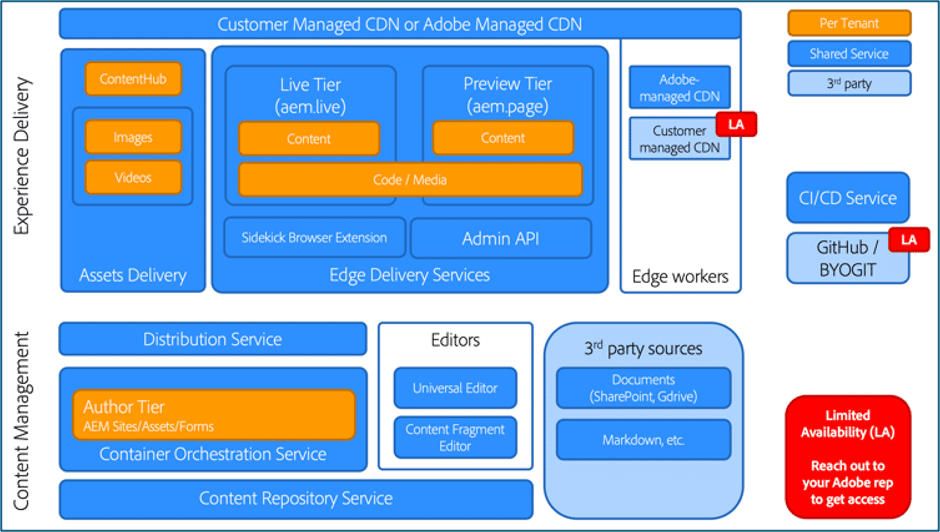
Adobe’s architectural push toward Edge Delivery Services and Commerce Optimizer is often framed as a developer performance play. That framing undersells what it actually enables.
Edge Delivery enables native experimentation with generative AI text and image variations, including content generated through Adobe Firefly, adapted directly in the content supply chain. The real value is operational: teams can test and iterate on product content at a pace that static CMS workflows cannot match. A headless storefront without modernized content operations is a fast site serving stale content. The performance gain without the content discipline does not compound.
Customer Journey Analytics extends this further. Most commerce operators stop at standard ecommerce reporting. CJA allows you to ingest platform datasets, analyze top and bottom converting paths, and use those journey signals to systematically adjust search configurations and merchandising rules based on observed friction. The connection between journey analysis and storefront configuration is where most teams leave significant ground on the table.
The B2B Complexity Layer
Activating these capabilities is significantly harder in B2B manufacturing and distribution contexts. It is also significantly more valuable.
Adobe Commerce is built for B2B structural complexity: multi-storefront operations, company accounts, customer-specific catalogs, negotiated pricing, and purchase approval workflows. Because B2B storefronts function as self-service portals supporting dealer ecosystems and reducing inside-sales burden rather than as conventional shopping carts, teams often assume their catalog is simply too complex for AI-driven search or unified CDP journeys. They leave the AI layer dormant and keep running the same manual merchandising rules they used three platforms ago.
Middleby is a useful proof point. When McFadyen Digital delivered Middleby Shop on Adobe Commerce, the goal was to unify multi-brand journeys across a portfolio spanning more than 100 brands, from small equipment parts to large commercial cooking systems, without forcing buyers to navigate disconnected sites. The platform needed to support a quoting workflow with full catalog access while keeping dealer and channel partner relationships central to pricing, delivery, and installation.
In that environment, AI-augmented search, dynamic relevance, and guided discovery are not marketing features. They are the usability layer that makes a dense, multi-brand catalog navigable. The ability to combine catalog data with behavioral signals is what allows a kitchen operator to browse an enormous portfolio and build a complete commercial kitchen quote in a single session. Complexity is not a reason to skip AI activation. In most B2B contexts, it is the primary reason to prioritize it.
AI Discoverability: The Next Frontier
Optimizing for on-site search is no longer sufficient. As buyer behavior shifts toward AI assistants and agentic browsers, the question of how your products and brand appear in AI-generated responses is becoming a real commercial consideration.
Adobe’s LLM Optimizer is designed to measure and shape how your brand is cited in these AI-driven discovery environments, using an edge deployment that targets agentic traffic without touching the experience for human users. If you are thinking carefully about how AI systems find and represent your products, we covered this in depth in our published piece on Generative Engine Optimization and Adobe LLM Optimizer for B2B commerce leaders. That is the deeper read.
What to Do Before Summit
Adobe Summit 2026 arrives in April. Adobe will use those sessions to push the narrative toward AI-first ecosystems, agentic commerce standards, and composable SaaS architecture. You will hear about the future of AI-assisted buying experiences and generative experimentation across the stack.
Before you sit in those sessions planning for what is coming, audit what you already have.
If your headless storefront is silently failing to pass behavioral events back to Live Search, your foundation is broken regardless of what Adobe announces next. If your recommendations are stalled on a cold-start problem, or your CDP integration only flows in one direction, new feature releases will land on an unstable base.
The teams that will actually capitalize on Adobe’s future roadmap are the ones who have already done the unglamorous work: event data rigor, closed-loop audience activation, continuous optimization cadences, and content operations that can support real experimentation. Summit is a useful accelerant. It is not a substitute for platform depth.
McFadyen Digital has been working inside Adobe Commerce implementations long enough to know where the gaps consistently appear. We know what gets skipped at go-live, what stalls in phase two, and what the mature activation path looks like. That is the conversation we will be having at Summit. We hope to see you there.
See It in Practice at Adobe Summit
Everything described in this piece comes to life in our Adobe Summit session. McFadyen Digital and The Middleby Corporation are presenting Unified Commerce for Manufacturers: One Platform, Many Brands at Adobe Summit 2026. The session covers how Middleby Shop on Adobe Commerce connects more than 60 brands under a single commerce experience, aligns dealer and distributor channels without creating a conflict and enables B2B buyers to research, quote and design complete kitchen solutions across product lines.
Register to attend our virtual session here: Add session to your Summit schedule.
Related Articles

Turn Insight Into Impact.
Start Today.