
Written by: Jeff Mikos
Reading time: 6 minutes

Updated: 04/08/2026
Published: 04/02/2026
Fewer than 10% of today’s 50,000+ AI companies will still be operating in five years.
That single data point — from our newly published AI Best Practices for Commerce — is not a warning against AI investment. It is a warning against the wrong kind. Against chasing tools rather than building capabilities. Against confusing activity with progress.
Because here is what we know after four decades in commerce technology, and after spending the past year documenting more than 100 AI use cases across the commerce value chain: the organizations winning with AI are not the ones with the most tools. They are the ones with the clearest framework for deciding which capabilities to build, when to build them, and what has to be true before any of it works.
That framework is what this post is about.
We Are at the Beginning of the Third Era of Commerce
Commerce has been rewritten by technology three times.
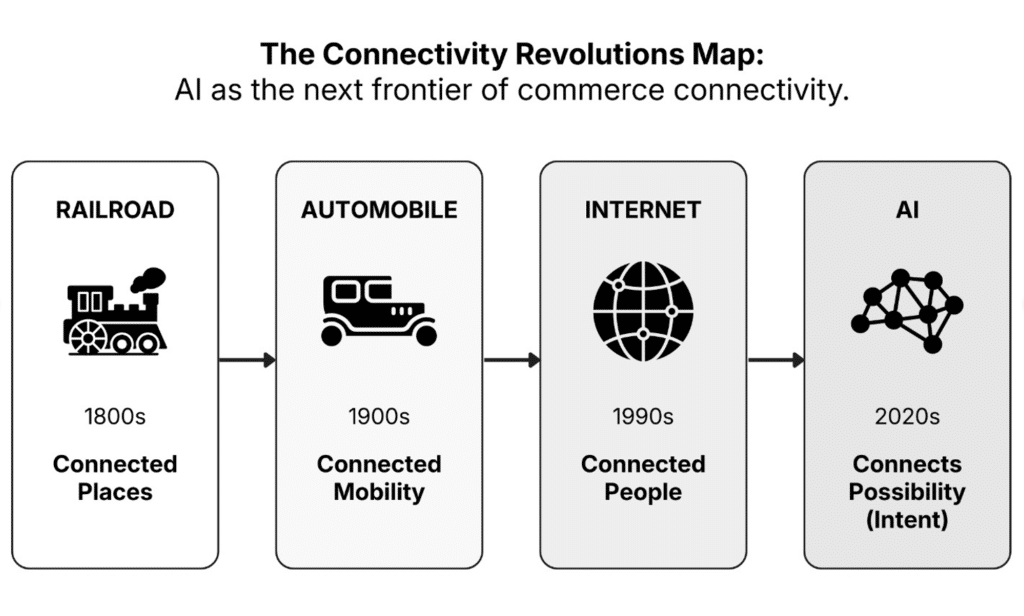
- The first era was physical — waterways, railroads, storefronts. Transactions were tied to place.
- The second era was digital — web, mobile, omnichannel. Transactions moved online but remained tied to channels.
- The third era is intelligent. Adaptive, anticipatory, self-improving. And crucially, the store is no longer a place or a channel. It is wherever intent arises.
The railroad connected places. The internet connected people. AI connects possibilities — it moves with intent.
This shift is not theoretical. Walmart is embedding conversational checkout directly into ChatGPT. Nike uses AI to forecast demand for specific product sizes and adjusts inventories in real time. B2B distributors like Grainger use dynamic pricing that learns continuously from transaction data.
What these organizations share is not a single tool or vendor. They share an orientation: they are designing systems where every customer interaction, every product search, every order creates signal — and that signal feeds learning that makes the next interaction better.
That is what intelligent commerce looks like in practice. And it is very different from deploying an AI feature.
AI Is an ‘And,’ Not an ‘Or’ — This Changes Everything About How You Invest
Every previous technology revolution had a signature exchange. Muscle for machine. Wire for wireless. Analog for digital. Each replaced a limitation with a new capability.
AI is different. It does not replace so much as compound. It is not automation or creativity, efficiency or empathy, human or machine. It is both.
A merchandising team can use AI to evaluate a thousand campaign variations and still devote more time to the emotional core of a message — because AI handles the variations. A logistics planner can automate routing and focus on supplier relationships. A developer can generate boilerplate code and concentrate on architecture.
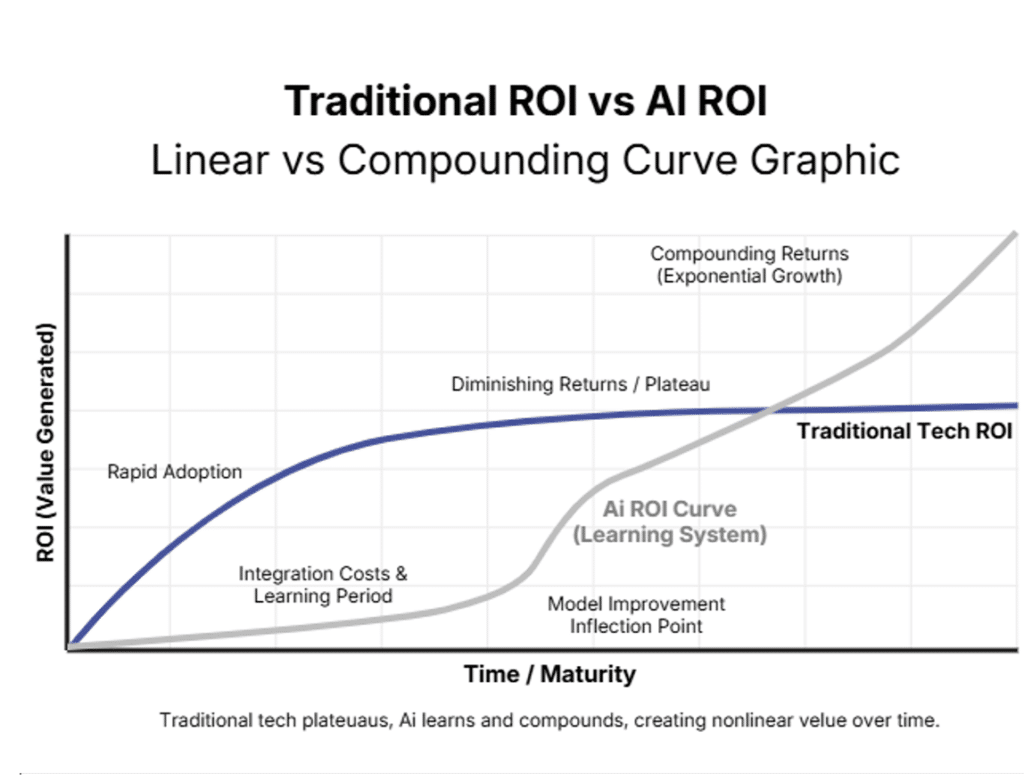
This compounding effect is why AI feels simultaneously destabilizing and full of promise. It does not follow the linear logic of previous technology investments.
Traditional ROI assumes diminishing returns. AI delivers compounding returns. The first hundred predictions a model makes are less accurate than the ten-thousandth.
This non-linearity has a critical implication for investment strategy. The organizations that start building AI capabilities now are not just ahead — they are compounding that advantage every day. Their data becomes experience. Their experience becomes differentiation. And that gap is genuinely hard to close once it opens.
The AI Flywheel: Why Early Movers Pull Away Permanently
The mechanism behind this compounding advantage has a name: the AI flywheel.
Every AI interaction teaches the next one. A pricing algorithm that optimizes daily margins also captures new price elasticity data, refining itself with each iteration. A recommendation model that boosts click-through also improves its understanding of product affinities. The flywheel spins faster with every cycle.
For commerce organizations, this creates a strategic imperative that is hard to overstate. The question is not whether to invest in AI. It is how quickly you can build the foundations that let the flywheel spin.
And that brings us to what actually stops it.
The Real Bottleneck Is Not the Tool. It Is the Data.
Ask most commerce leaders why their AI initiatives underperform, and they will point to the vendor, the implementation, or the team. Rarely do they point to the data — even though the data is almost always the real answer.
AI runs on first-party data. Not cookies. Not purchased lists. Not aggregated intent signals from external brokers. The clean, consented, behavior-level information collected directly from customers, suppliers, and transactions — that is what intelligent commerce runs on.
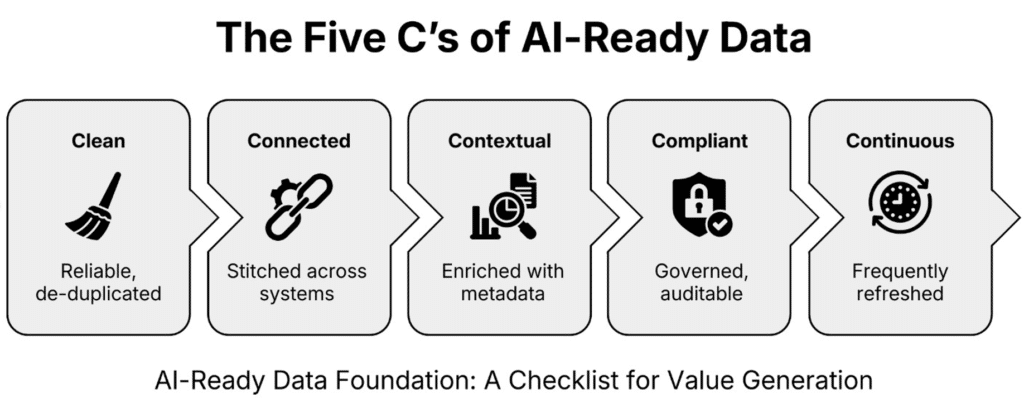
We use a framework called the Five C’s to diagnose AI data readiness. Every word matters:
- Clean — reliable, de-duplicated, fit for purpose. At AI scale, small inconsistencies become systemic distortions.
- Connected — linked across systems so context follows the customer, the product, and the order across ERP, CRM, OMS, and marketing systems.
- Contextual — enriched with meaning, metadata, and semantics so models understand what the numbers represent.
- Compliant — privacy-safe, governed, and auditable. Trust by design, not afterthought.
- Continuous — refreshed frequently enough that models track reality, not history.
Perfection is not required on day one. But visible progress across all five traits is. Organizations that treat data quality as a prerequisite — rather than something to fix after the model underperforms — consistently outpace those that do not.
The Balanced AI Portfolio: How to Sequence Investment for Compounding Returns
The final piece of the framework is sequencing. Not every AI initiative delivers equal return, and organizations that invest without a portfolio logic — chasing the most visible or exciting use cases first — consistently underperform those that balance across three investment horizons.
Horizon 1: Efficiency plays. 6–12 months — Automation and augmentation with clear, measurable ROI. Customer service copilots, automated product tagging, predictive inventory alerts, email generation. Low to moderate cost. Build credibility and create organizational muscle memory.
Horizon 2: Capability building. 12–24 months — Infrastructure and platform investments that do not deliver immediate financial returns but unlock future possibilities. Unified data platforms, governance frameworks, experimentation infrastructure. Without this layer, every new AI project becomes a custom integration nightmare.
Horizon 3: Differentiation bets. 24+ months — Proprietary capabilities that create competitive moats. Custom recommendation engines trained on years of behavioral data. Agentic systems that autonomously manage workflows. These are the investments competitors cannot easily replicate.
The failure modes of imbalance are specific and predictable. Too much Horizon 1, and you become an efficient operator of commodity AI tools — competitors who invest in deeper capabilities pull ahead. Too much Horizon 2, and you build infrastructure no one uses. Too much Horizon 3, and you chase moonshots without the foundation to support them.
A balanced starting point: roughly 50% Horizon 1, 30% Horizon 2, 20% Horizon 3. Adjust as maturity grows.
What This Means for Commerce Leaders in 2026
The AI revolution is not uniform. Not every tool is worth buying. Not every vendor will survive. And not every AI initiative will compound into competitive advantage.
What separates the organizations that will shape the next decade of commerce from those that will spend the next decade catching up is not ambition or budget. It is the quality of the framework they use to make decisions.
Understand which era of commerce you are designing for. Build capabilities that compound, not just tools that automate. Fix the data before you blame the model. And invest across all three horizons — because the flywheel only spins if the foundation holds.
The AI Commerce Readiness Audit scores your commerce site across five critical dimensions — AEO/GEO readiness, SEO, content quality, performance, and accessibility — in under five minutes. Free. No account required. Start at AI-Powered Commerce Audit | McFadyen Digital
About This Research
The frameworks and insights in this post draw from AI Best Practices for Commerce, McFadyen Digital’s 500-page research publication documenting AI use cases, vendor landscapes, implementation guidance, and ROI analysis across the commerce value chain. It is the fourth book published by the McFadyen team and the third in their Best Practices series.
About McFadyen Digital
McFadyen Digital has been at the forefront of commerce technology for nearly four decades. We help distributors, manufacturers, and retailers build the infrastructure, capabilities, and strategies that make intelligent commerce possible. Learn more at mcfadyen.com.
Related Articles



Turn Insight Into Impact.
Start Today.