
Written by: McFadyen Digital
Reading time: 4 minutes
Updated: 05/22/2026
Published: 05/22/2026
This week, Google spent two days announcing the future of commerce. Most of the coverage focused on what this means for retailers and consumer brands. That is the wrong lens for distributors and manufacturers.
Here is the more useful question: when Google builds infrastructure that trains your buyers to expect frictionless, AI-assisted purchasing in their personal lives, what happens when those same buyers show up to work on Monday morning?
B2B buyers do not stop being consumers when they get to work.
What Google Actually Built
The headline feature from Google I/O 2026 was Universal Cart. It is a single, persistent, AI-powered cart that spans Search, Gemini, YouTube, and Gmail. Add a product anywhere, and it automatically monitors price drops, checks compatibility, surfaces alternatives, and completes the purchase on your behalf. The underlying infrastructure is the Universal Commerce Protocol (UCP), an open standard co-developed with Shopify, Walmart, Target, and Wayfair. Alongside it, Google’s Agent Payments Protocol (AP2) now supports what Google calls “Human Not Present” purchases: autonomous transactions completed by AI agents within user-defined guardrails.
This is not a roadmap item. UCP is in production. AP2 v0.2.0 shipped in April. Universal Cart rolled out in the U.S. this week.
The commerce infrastructure Google is building does one specific thing: it inserts an AI layer between the buyer’s intent and the merchant’s transaction. For consumer brands, that layer is already here. For B2B, the clock has started.
The Expectation Gap Is the Real Problem
Technology has always worked this way. Amazon made two-day delivery the baseline, and every supply chain felt the pressure. Uber made real-time status tracking the standard, and every service business without it looked like it was behind. The iPhone reset consumer UX expectations so completely that enterprise software spent a decade catching up.
Google’s announcements this week are the next version of this pattern. The difference for B2B is that the gap between what buyers now expect and what most distributor and manufacturer commerce platforms actually deliver is already significant and growing.
Your buyers are being trained right now, in their personal lives, by AI agents that synthesize options, surface the best price, check compatibility across a mixed cart, and complete a purchase without a multi-step procurement process. They are building muscle memory for frictionless buying. That muscle memory does not stay in their personal browser.
Why B2B Has a Window, and What It Is Worth
Here is where the B2B reality check matters. Google’s UCP does not currently navigate the structural complexity of enterprise procurement. Negotiated contract pricing, customer-specific catalogs, credit terms, tax exemptions, ERP-tied order workflows: none of that lives inside the protocol today. An AI agent operating through UCP cannot place a quote-required order for 10,000 units at a customer-specific price with freight calculations tied to three distribution centers.
That is not a permanent limitation. It is a 12-to-18-month window.
The distributors and manufacturers who use that window well are not the ones who attempt to block agent access to their platforms. They are the ones who make a deliberate architectural decision about where the transaction completes and build toward it. The goal is not to prevent your buyers from using AI agents. It is to ensure that when those agents come looking, your catalog can be read, your pricing can be surfaced, and your checkout path does not require a human to intervene at every step.
Forrester projects that 20% of B2B sellers will face agent-led quote negotiations by end of 2026. That number will look conservative by 2028.
What to Do in the Next 90 Days

This does not require a platform overhaul. It requires clarity on where you actually stand.
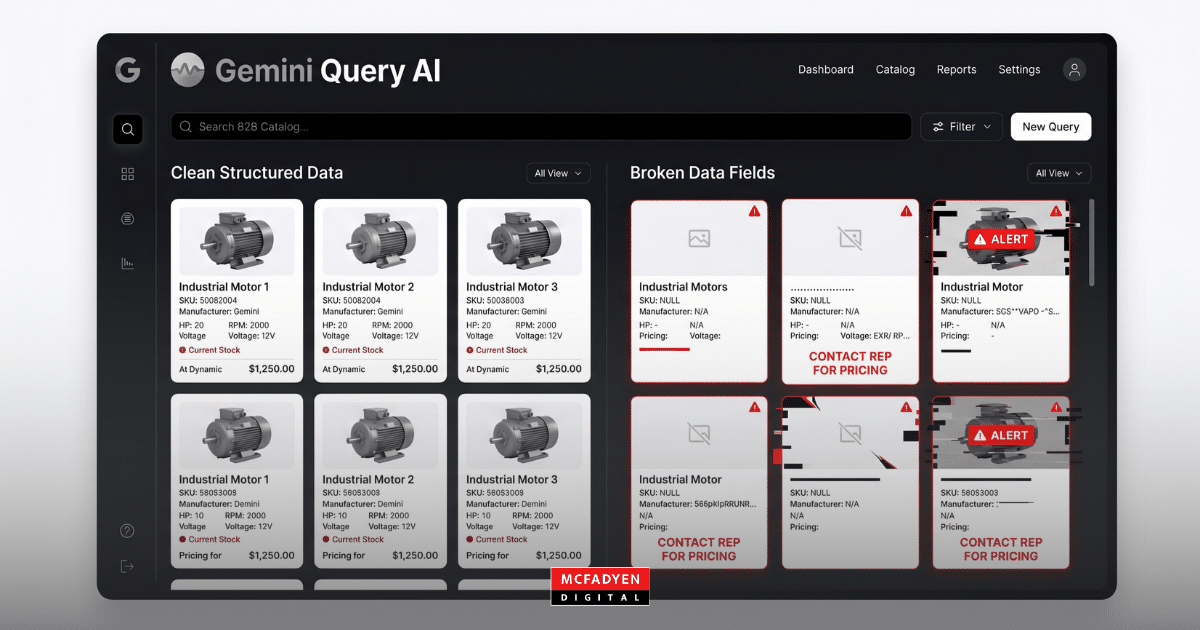
- Audit your machine-readability. Can an AI agent parse your catalog and return meaningful results: specifications, compatibility, substitutes, pricing tiers, real-time inventory? If your product data lives in PDFs, inconsistent attribute structures, or a legacy PIM without a clean API, you are invisible to agent-driven discovery before the transaction question even comes up.
- Map your checkout against agent requirements. Trace the path from product selection to completed order. Count the steps that require human intervention: a rep call, a quote approval, a manual price lookup. You do not need to eliminate all of them immediately. You need to know which ones are structural and which are solvable in the near term.
- Have the protocol conversation with your platform partner now. UCP and OpenAI’s Agentic Commerce Protocol are competing for the infrastructure layer that will sit between your buyers and your catalog. Both require specific API architecture, authentication frameworks, and catalog attribute standards. This is a design decision, and it is significantly harder to make correctly after a platform refresh than before one.
The Position That Matters
Google did not ship a set of features this week. They shifted the architecture of buyer expectation. The question for every distributor and manufacturer is not whether to respond to that shift. It is whether to respond deliberately or reactively.
The commerce organizations that will look back on 2026 as a turning point are the ones that recognized the window when it opened and made the architectural decisions while they still had time to make them on their own terms.
McFadyen Digital works with distributors, manufacturers, and marketplace operators building commerce infrastructure for exactly this kind of inflection point. The complexity is real. The window is not permanent.
Related Articles

Turn Insight Into Impact.
Start Today.