Written by: Jeff Mikos
Reading time: 7 minutes
Updated: 05/21/2026
Published: 05/21/2026
The conversations were candid, the data was sobering, and one theme kept surfacing across every session: this is a leadership and change management story before it is a technology story.
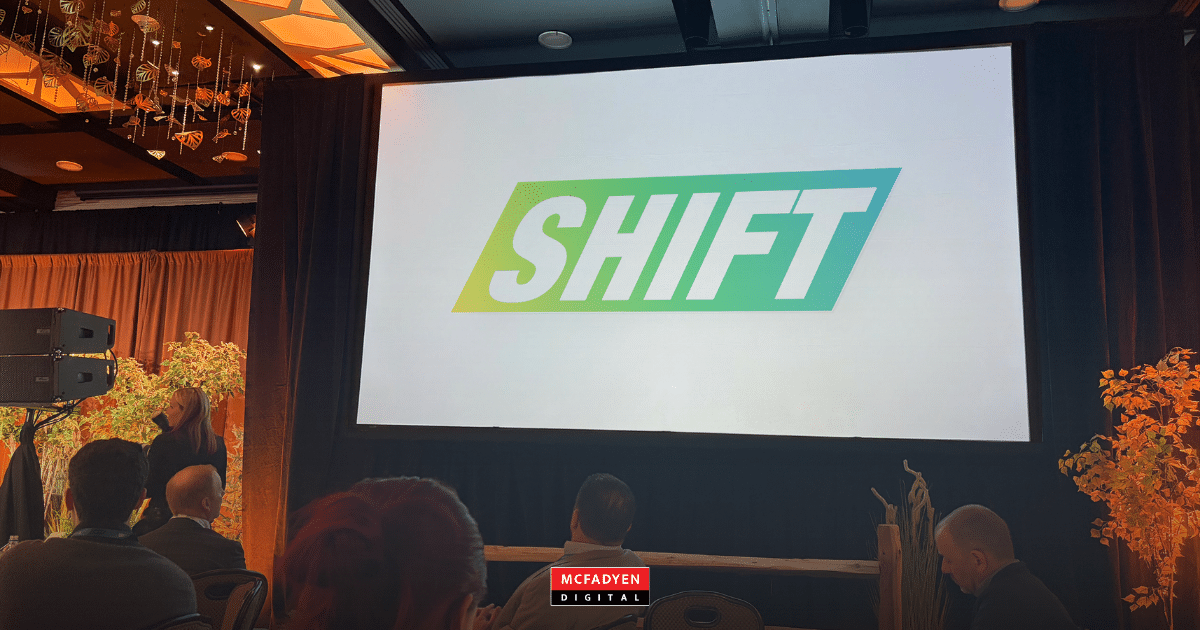
I just got back from MDM SHIFT 2026 in Denver, and my head is still spinning in the best possible way. McFadyen Digital sponsored the Digital Cohort, and I had the privilege of spending two days in a room with some of the sharpest operators in the distribution industry. The caliber of conversation, the honesty of the exchanges, and the quality of the programming made this one worth every minute.
One thing worth noting upfront: AI was everywhere at SHIFT, but the energy was grounded. Nobody in that room was debating whether to adopt it. That question is settled. The live questions were: where do we start, how do we govern it, and how do we avoid automating broken processes at scale. Those are harder questions, and they generated better conversations.
After two wonderful days at this event, here are the six takeaways I have from MDM SHIFT 2026:
1. The #1 Differentiator in AI ROI Is Not What You Expect
It is not data readiness. It is not your tech stack or any specific tool. It is not company size or industry vertical. The companies winning in AI share one common thread: a single believer at the top of the org chart.
Where leadership is genuinely bought in, enabling their teams and modeling the behavior, AI initiatives are moving. Where AI is treated as a priority on paper or delegated without real executive support, things are stalling. Full stop.
McKinsey’s 2025 State of AI research found that senior leadership ownership is one of the top factors that distinguishes AI high performers from everyone else — those rare organizations, roughly 6% of the market, that attribute more than 5% of EBIT to AI. Paul Miller of McKinsey put it plainly during one of the SHIFT sessions. Paraphrasing, he said “This is NOT tech. This is change management. Internal adoption.” That framing resonated across the room because it matched what people were experiencing in their own organizations.
Why You Should Care: If you are waiting for the right data, the right platform, or the right budget cycle, you may be solving the wrong problem. Look up the org chart first. Is there a sponsor with the authority and conviction to clear the path? If not, building that sponsorship is likely the highest-leverage thing you can do right now.
2. Change Management Is the Real Workload
This was the dominant theme of the conference, confirmed from every direction. McKinsey’s benchmark for their own AI transformation engagements is 20% technology and 80% change management, process documentation, and redesign. Virtually every failed project story shared across sessions came back to people, not platforms.
People are exhausted. The list of priorities grows and rarely shrinks. Several attendees described a pattern of new ideas constantly jumping the queue, disrupting in-flight work, and exhausting the teams responsible for execution. AI is making this worse in a specific way: the pace of new ideas is genuinely outpacing project management capacity in most organizations. Technology moves faster than the humans tasked with deploying it.
The data across industries makes this pattern hard to ignore. A Deloitte 2025 survey of 1,854 executives found that most organizations take two to four years to achieve satisfactory ROI on a typical AI use case — significantly longer than the seven to twelve months traditionally expected for technology investments. Only 6% reported payback in under a year. A 2025 IBM global study of 2,000 CEOs found that only 25% of AI initiatives delivered expected ROI, and merely 16% scaled successfully across the enterprise. This is not a technology problem. It is an organizational one.
Even the big AI labs are recognizing this. McKinsey’s own research found that employees are already using AI three times more than their leaders realize — but simply putting technology in people’s hands does not ensure they use it effectively. OpenAI recently stood up the OpenAI Deployment Company, a separate entity that raised $4 billion at a $10 billion valuation, specifically to help organizations tackle the human side of AI implementation.
Why You Should Care: Your AI roadmap probably has a technology section. Does it have a people section? The MDM/NAW In Pursuit of Value research found that between 65% and 77% of distributors pursuing AI across all five opportunity areas have seen no measurable margin improvement to date. That is not a technology failure. It is a change management gap.
3. AI Entered Through the Front Door, and It Came Through Quoting
Not e-commerce. Not the warehouse. Quotes.
This came up in nearly every session and every roundtable at SHIFT. A clear hierarchy of AI entry points emerged from those conversations, reinforced by McKinsey’s own framing. Quote automation was the undisputed number one use case mentioned. Touchless order entry was close behind, with one attendee reporting 55% adoption after rollout. Further down the hierarchy, top-of-funnel revenue generation was flagged by McKinsey as the most overlooked AI opportunity in distribution, with most companies chasing cost reduction first and missing the growth flywheel entirely.
Worth calling out: e-commerce was notably absent as an AI starting point in those conversations. Attendees simply do not frame their AI journeys that way. Leading with e-commerce as the entry point positions you behind the conversation that is actually happening in the market.
The underlying reason quote automation dominates is straightforward. Speed wins. Whoever gets a quote back to the contractor first is probably going to get the order. That contractor is not going to wait hours to save a few dollars.
Why You Should Care: If your quoting process is still largely manual, you have a visible vulnerability. The entry point to digital transformation in distribution right now is not the catalog. It is the quote.
4. You Don’t Need Perfect Data to Start
One of the most liberating moments at the event: when the room was asked who has perfect, unified data, virtually no hands went up. Not one. And yet AI is being deployed and delivering value across those same organizations.
It turns out that room was a perfect cross-section of enterprise reality. A joint Cloudera and Harvard Business Review study from October 2025 found that only 7% of enterprises say their data is completely ready for AI, and more than one quarter report their data is not very or not at all ready. A Dun and Bradstreet study published this month found only 5% of enterprises say their data is ready with high confidence. Nobody has perfect data. And yet AI is moving forward anyway.
McKinsey was explicit on this point at SHIFT: AI tooling has matured to where imperfect data is workable, and the cost of waiting is now higher than the cost of starting imperfect. The goal they recommend is a 3-month proof of value, not a 3-year transformation.
The distribution-specific research backs this up as well. According to the MDM/NAW In Pursuit of Value study, 41% of small distributors who reported investing $0 in AI were actively exploring or piloting it in at least one category, often using free tools and internal hustle rather than formal budgets. The barriers that once required massive IT spend and dedicated data science teams are falling.
The so what: The “fix your data first” objection is largely obsolete. Start where you are. The data you have in your ERP today, imperfect as it is, is enough to begin generating value in demand forecasting, pricing optimization, and customer service automation. Waiting for perfect data is a strategy for watching your competitors move first.
5. AI the Process vs. AI-ing the Process
This is the distinction that matters most to me coming out of SHIFT. Dropping AI on top of a broken or inefficient process just scales the problem. The real value, the transformational value, comes when you use AI as the forcing function to rethink the process entirely.
The canonical example from the conference: one attendee had fully automated their expedite workflow with AI. Orders were still being expedited. Just faster. They had scaled a symptom. The real question, the one that should have been asked at the start, was why those orders needed expediting in the first place.
Jenni Detert, VP of IT at Endries International, shared a similar story on the main stage. Her team automated a purchasing workflow with AI only to realize months in that they had, in her words, “just kind of automated chaos.” The real opportunity was using AI to diagnose why the problem existed, not automate around it.
Multiple sessions surfaced the same warning: ask why five times before you automate anything. McKinsey’s Rewire framework, referenced in several conversations, begins with a value-based roadmap, not a use case list or a technology selection. Start with a specific, measurable business outcome and work backwards. McKinsey’s 2025 State of AI research found that AI high performers are 2.8x more likely to report fundamental workflow redesign compared to other organizations (55% vs. 20%). That is not a coincidence. The organizations doing this are getting real value. The ones that started with a tool and tried to reverse-engineer the value after are struggling.
There is also a subtler version of this problem worth naming: the stranded cost trap. When AI saves everyone 5% of their time, that savings is often invisible on the P&L. It does not translate to headcount reduction or captured cost savings. It disappears into the noise. Real value comes from redesigning end-to-end journeys, not automating individual tasks.
The so what: Before you layer AI onto any workflow, ask: if we redesigned this process from scratch today, knowing what AI can do, what would it look like? The answer to that question is usually more valuable than the automation project you were about to fund.
6. The Cohort Energy Was Something Else
Sitting in a room with a couple dozen operators who are all wrestling with the same real problems, prioritization, change fatigue, data chaos, adoption uncertainty, and watching them help each other? That is the part you cannot get from a webinar.
The distribution sector is navigating a genuinely hard moment. According to the MDM/NAW research, 54% of distributors have not yet placed logistics and delivery AI on their roadmap at all, and across every opportunity area surveyed, the majority of respondents have yet to see measurable margin improvement. This is still early innings. And it mirrors what is happening across industries: McKinsey found that nearly two-thirds of organizations have not yet begun scaling AI across the enterprise, despite near-universal adoption in at least one business function.
But the prioritization pressure is real and growing. Too many initiatives, not enough bandwidth. Attendees described a pattern of new ideas constantly jumping the queue, disrupting work that is already in flight. AI is accelerating this in a specific way: the pace of new possibilities is genuinely outpacing organizational capacity to evaluate and deploy them. The cohort conversations were as much about saying no strategically as they were about which AI to pursue.
The so what: Early innings is not bad news. It is an opportunity. The distributors who are learning now, even through failed pilots and imperfect data, are building institutional muscle that compounds over time. The ones who wait for the playbook to be fully written will be playing catch-up.
A Final Thought
The numbers are consistent whether you look at distribution specifically or enterprise AI broadly. The MDM/NAW research shows that 73% of distributors pursuing AI in pricing expect margin improvements of 2% or more, but only 16% have achieved it. Deloitte found that only 6% of organizations realize AI ROI in under a year. IBM found that only 16% of AI initiatives have scaled successfully. None of this is a signal that AI is underdelivering. It is a signal that most organizations are still in the exploration phase, and that the returns are ahead of them, not behind.
The question is not whether AI will transform distribution. It will. The question is whether your organization is building the leadership alignment, change management capacity, and process discipline to capture that value when it arrives.
SHIFT reminded me that the companies figuring that out first will not just have better margins. They will have a fundamentally different kind of business.
Related Articles


Turn Insight Into Impact.
Start Today.