Written by: McFadyen Digital
Reading time: 5 minutes
Updated: 06/19/2026
Published: 06/19/2026
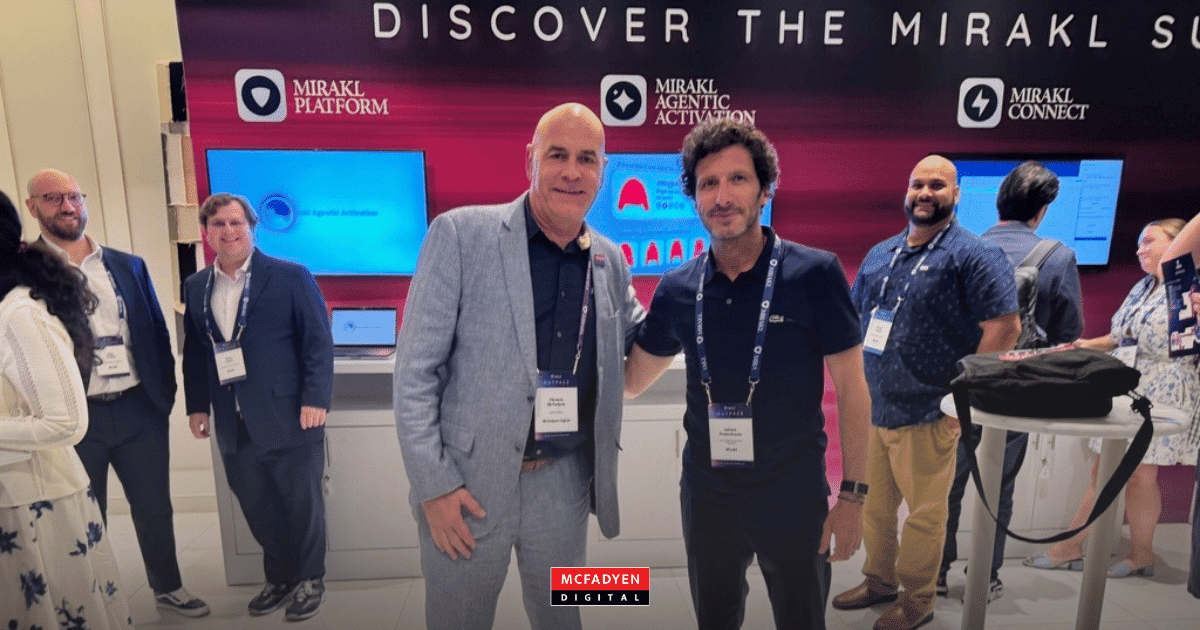
Adrien Nussenbaum opened the Mirakl Summit in New York this month with a declaration: the era of telling people that marketplaces are the future of commerce is over. They are the present. And in his framing, the present is already urgent.
He is right. But the most important thing said at that Summit was not in the keynote. It came from the operational sessions, the customer panels, and a piece of research from Accenture that most attendees may have moved past too quickly: the companies that will capture the next era of commerce are not the ones with the most sophisticated AI roadmap. They are the ones that built the operational foundation before the AI stakes got this high.
That distinction matters more than it might seem. And it is the conversation most organizations need to be having right now.
The Keynote Got It Right. The Hard Part Comes After.
The central thesis from Mirakl this year was clear: marketplace is no longer a channel strategy. It is the operating model for intelligent commerce. Assortment at scale, supplier ecosystems, retail media, AI-ready catalog infrastructure. These are not features of a mature marketplace program. They are the table stakes for competing in the next three to five years.
The customer stories reinforced it. Lowe’s launched the home improvement industry’s first comprehensive marketplace and is already treating the marketplace-retail media flywheel as a core growth engine. Ulta Beauty launched its marketplace just months ago and won the event’s Launch Faster award, going from zero to a curated marketplace in eight months with Mirakl Payout and Mirakl Ads live in year one. Home Depot is using the platform not as a traditional marketplace at all, but as a catalog onboarding and extended aisle engine that scales long-tail supplier relationships without proportional operational overhead.
These are not pilot programs. They are production systems. And they all have one thing in common: the operators behind them made foundational decisions about data standards, supplier onboarding workflows, 1P/3P governance, and catalog quality , before the AI conversation became this urgent.
The Part That Did Not Get Enough Attention
Accenture presented research at the Summit that should have stopped more people in their tracks. Based on a simulation of 50,000 synthetic consumers across 24 countries, they found that 86 percent of AI agent-mediated transactions are at risk of being abandoned or switched to a competitor when something goes wrong in the purchase process. Inventory too limited, data inaccurate, payment authorization failing, delivery windows unclear, returns difficult, the agent simply moves on, often in milliseconds. (Accenture, “Agentic Commerce: The Dawn of Agentic Commerce,” 2026.) Separately, their research found that 25 percent of products discovered through LLM-based search were 3P marketplace items that won over their 1P counterparts. Not because they were better products, but because their data was more complete, their pricing was current, and their fulfillment metadata was accurate.
The buy box is not going away. It is moving into the agent layer. And the operator who wins it will be the one whose catalog data is structured well enough to be chosen.
That is a present-tense operational problem, not a future AI strategy question. Agents are already making product selection decisions based on data completeness, pricing accuracy, inventory availability, and fulfillment reliability. If those fundamentals are not in order, a sophisticated AI roadmap does not close the gap.
The workshop sessions at the Summit made this visible in a different way. Rooms full of marketplace operators at various stages of maturity were asking the same questions: How do we structure our operating model? How do we align 1P and 3P incentives? How do we manage seller onboarding at scale? These are not questions about AI. They are questions about the organizational and data infrastructure that AI depends on.
The Operating Model Gap Is the Real Conversation
There is a wide gap between the vision articulated at a Summit keynote and the operational reality most commerce organizations are actually managing. The gap is not a technology problem. Platforms are capable. The gap is a readiness problem , and it shows up in three specific places.
The first is catalog data. Most organizations have product data living across multiple systems, managed by different teams, with inconsistent standards for completeness, accuracy, and enrichment. In a world where agents select products based on data quality, this is not a content problem. It is a revenue problem.
The second is supplier onboarding. The extended aisle model only works if suppliers can get products live quickly, keep data current, and respond to operational signals in near real time. Most onboarding processes were not designed for that. They were designed for annual catalog uploads and quarterly reviews.
The third is 1P/3P governance. The most common organizational challenge we hear from marketplace operators is not technical. It is the misalignment between teams that own 1P inventory and teams that manage 3P sellers: different incentives, different metrics, different definitions of what success looks like. Resolving that is not a platform configuration. It is an operating model design decision.
Companies that have done this work are positioned to layer AI on top of a functional foundation and see real returns. Companies that have not are at risk of deploying AI that surfaces problems faster rather than solving them.
What the Leaders at This Event Have in Common
Lowe’s, Ulta Beauty, Home Depot, and Lacoste are very different businesses. Different categories, different customer relationships, different marketplace strategies. But they share something that does not show up in the platform demos: they each approached the marketplace model as an operating model decision, not a technology deployment.
Lowe’s built the seller ecosystem and the retail media flywheel together, treating them as interdependent rather than sequential. Ulta Beauty launched with a curated brand set designed around its 46 million Rewards members. Assortment decisions were driven by loyalty data, not by how many sellers they could onboard. Home Depot built supplier onboarding infrastructure that lets long-tail suppliers manage their own catalog, pricing, and promotions through self-service tooling, removing the human bottleneck that slows most extended aisle programs.
Lacoste’s Deputy CEO, Jan Maus, made a point that landed differently than the others: a premium brand choosing which marketplaces to participate in is now making a decision about where it wants to be recommended by AI models. Marketplace presence has become part of brand discoverability in the LLM layer. Being on the right platforms, with complete and accurate product data, is how a brand stays visible in an agent-mediated buying journey.
That is a strategic implication most organizations have not fully absorbed yet.
Where to Focus
The Mirakl Summit this year confirmed what we have been seeing in the market: the organizations that will capture the most value from AI-enabled commerce are not starting from AI. They are starting from the operational questions that AI depends on.
Before asking what AI can do for your commerce program, the more productive questions are:
- Is your product catalog structured well enough to be chosen by an agent rather than a human?
- Can your suppliers keep pricing, inventory, and fulfillment data current at the speed AI-mediated transactions require?
- Do your 1P and 3P teams share a definition of what good catalog performance looks like , and do they have the governance to act on it together?
- Is your supplier onboarding process fast enough to keep pace with the assortment breadth your customers now expect?
If the answers are uncertain, the work to do is not an AI strategy. It is an operational readiness assessment. That is where the competitive distance is actually being created right now.
If you are working through these questions, or want an honest view of where your commerce operation stands. The McFadyen AI Commerce Readiness Audit is designed to give you that picture. Start at audit.mcfadyen.ai.
Related Articles



Turn Insight Into Impact.
Start Today.