Written by: McFadyen Digital
Reading time: 5 minutes
Updated: 04/28/2026
Published: 04/28/2026
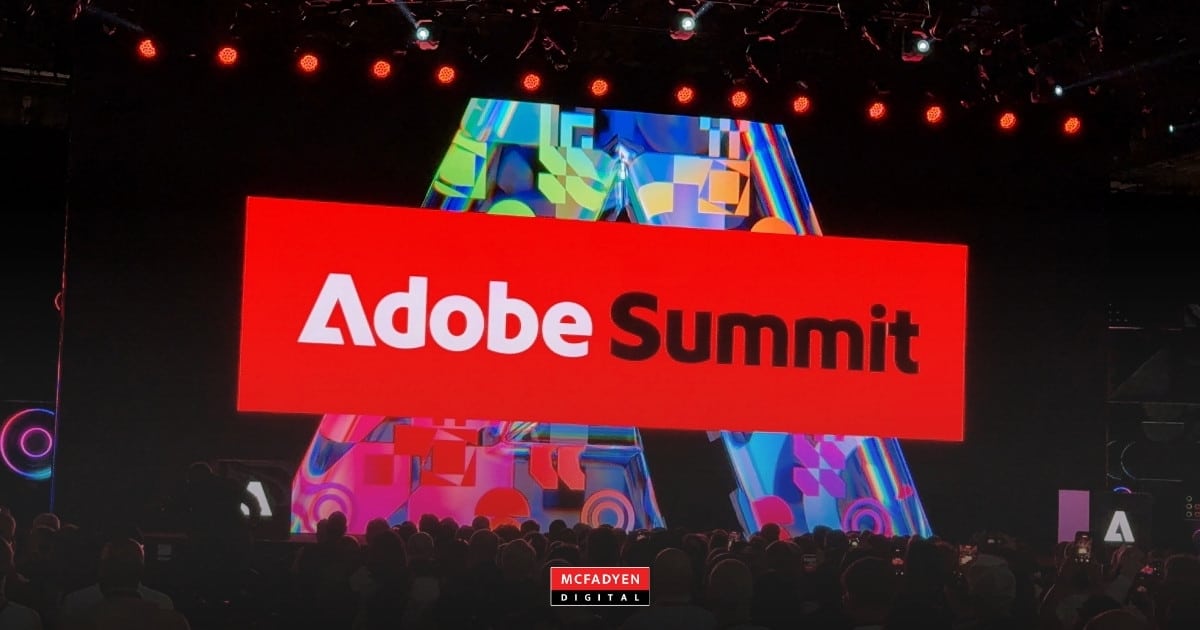
Last week Adobe Summit 2026 made one thing clear for digital commerce leaders: agentic AI is now the operating model, and commerce is where it shows up first. The headline announcements for B2B were not buried in the keynote. They sat in the Commerce track, and they are structural rather than incremental. The Commerce MCP server, new B2B drop-in capabilities, and Brand Concierge for storefronts together signal that Adobe Commerce is being rebuilt as an agent-native platform that the broader CX story wraps around.
Our team was in the sessions hearing first hand what was announced for commerce, how it fits into Adobe’s wider shift from AI-Assisted to AI-Orchestrated, qand what B2B leaders should do about it now.
The Big Picture: From “AI-Assisted” to “AI-Orchestrated”
If Summit had a single message, it was this: Adobe is no longer selling tools. It is selling an operating model. Adobe CX Enterprise, the flagship announcement, is an end-to-end agentic system that manages the customer lifecycle from acquisition through loyalty, sitting on an Adobe Experience Platform that processes more than 35 trillion segment evaluations a day. Agents inside that system aren’t guessing. They have memory, context, and history.
“Adobe CX Enterprise enables businesses to scale agentic AI with a fully customizable solution tailored to the needs of their organization, moving teams beyond AI experiments to tangible business outcomes.”
– Anil Chakravarthy, President, Customer Experience Orchestration Business, Adobe.
The competitive question in commerce has shifted. It is no longer who has the best UI or the most integrations. It is who controls the intelligence layer between your data, your content, and your customer touchpoints. Adobe is making a deliberate bid to own that layer, and the commerce announcements are how that bid lands for B2B.
What Adobe Announced for Commerce
We shared a first take of the announcements last week. Here is a more pointed take on the four announcements in the Commerce track matter most for B2B organizations evaluating platform decisions right now.
The New Front Door to Commerce Is AI
Adobe’s Commerce team put a stake in the ground: AI-native experiences are the standard, not the advanced track. The session “The New Front Door to Commerce Is AI. Are You Ready?” captures the question every B2B commerce team should be asking. AI traffic to U.S. retail sites climbed 269% year-over-year in March 2026. B2B buyers, who have always navigated more friction than B2C between complex catalogs, tiered pricing, and procurement workflows, are increasingly starting product research inside AI assistants. Brands that don’t show up accurately in those environments don’t exist in the consideration set. To combat that B2B companies must take a hard look at their PDPs, onsite agentic search, and AI discoverability. Data is only one part that is holding B2B organizations back. Exposing your site technically for AI to index and surface that data is another. That’s why Adobe has tools like LLM Optimizer to help companies prepare for this growing reality of customer product discovery.
Commerce MCP Server: The Agentic Commerce Layer
The most technically consequential announcement for commerce teams. Adobe Commerce introduced an MCP server that gives developers secure, real-time access to core commerce capabilities: catalog, cart, pricing, inventory, promotions, checkout, and order management. In plain language, Adobe is making commerce infrastructure accessible to the broader AI agent ecosystem. For B2B, this opens procurement agents, inside sales tools, AI-assisted RFQ workflows, and catalog assistants on a platform foundation that is now natively agent-ready.
B2B Drop-In Capabilities
Adobe Commerce announced drop-in capabilities aimed at the operational complexity of enterprise B2B relationships: company account management, negotiable quote management, requisition lists, and purchase order workflows. These are exactly the areas where current implementations typically require the most custom development. The drop-in model signals Adobe’s intent to reduce implementation burden while keeping configurability intact. McFadyen’s SmartLaunch for Adobe Commerce has been supplementing these needs through our accelerator and we’re excited to see B2B clients be able to take advantage of these new capabilities.
Brand Concierge for B2B Storefronts
Adobe Commerce’s integration with Brand Concierge brings conversational shopping directly into the storefront with real-time catalog data, accurate pricing, inventory visibility, and guided purchase journeys in a single continuous experience. For B2B buyers navigating complex catalogs, this is genuinely useful, not a cosmetic add-on.
How the CX Story Wraps Around Commerce
The broader CX announcements matter to commerce leaders because they determine how AI agents discover, engage, and convert buyers before they ever reach a storefront.
CX Enterprise Coworker is the product most likely to change how marketing teams operate day-to-day. Give it a goal, say a 3% lift in cross-sell, and it assembles audiences, creative, and performance data, builds a plan, waits for human sign-off, executes, and tracks results. That is autonomous execution within a governed framework, and for commerce it means campaign-to-conversion loops can close without manual handoffs.
Brand Visibility for the Agentic Web is the announcement that should accelerate every B2B leader’s sense of urgency. Adobe Experience Manager gains a contextual layer for AI agents, alongside Adobe LLM Optimizer and enhancements to Adobe Commerce designed to help brands understand and improve how they appear across AI-driven discovery surfaces. As Loni Stark, VP of Strategy and Product at Adobe put it, “There is a new intermediary between brands and their customers, and unlike every one that came before it, this has the ability to reason.”
Adobe Brand Intelligence and the GenStudio expansion round out the picture by keeping content output on-brand at the volume agentic systems will demand.
What’s Working and What Isn’t Yet Clear
The strategic narrative holds together. Adobe is not bolting AI onto legacy products. By building around open, composable standards and integrating with Anthropic, OpenAI, Google, Microsoft, and others, it is reducing the walled-garden risk that often limits enterprise adoption. The Commerce MCP server, drop-in B2B capabilities, and LLM optimization work address real pain, not vaporware.
The honest critique came from analyst Mark Vena: “Adobe’s strategy is more coherent than ever, but coherence is not the same thing as adoption.” Several capabilities, including CX Enterprise Coworker general availability, are still on “coming months” timeframes. The B2B commerce story, while substantive this year, still sits inside a Summit catalog dominated by B2C retail use cases. Organizations evaluating Adobe today should separate what is shipping now from what is on the roadmap. We tend to agree that the messages sounded great. It’s where the rubber hits the road today vs. in the future that B2B organizations must navigate.
The McFadyen Perspective and What to Do Now
Summit 2026 validates several things we have been telling B2B commerce clients for months. AI discoverability is the new SEO, and the 269% traffic shift in retail will follow into B2B. The agentic commerce opportunity in B2B is significant and underpenetrated, and the Commerce MCP server is the most important opening for it. The platform is one piece of the equation, not the whole equation.
For B2B commerce leaders, four moves matter now. First, audit how your products and services appear in ChatGPT, Gemini, and Perplexity today; for most B2B organizations the answer is not well, and that is your starting point. Second, walk any Adobe platform conversation directly through B2B-specific functionality against your actual buying workflows, not the generic demo. Third, scope agentic use cases in sales and procurement that the Commerce MCP server now makes possible. Fourth, reassess your implementation partner: as the technology surface expands, the value of a partner who can translate platform capability into B2B commerce outcomes goes up, not down.
The brands that win will be the ones who show up in AI discovery, convert on owned experiences, and evolve fast enough to keep pace. That requires more than a platform purchase.
Related Articles
Turn Insight Into Impact.
Start Today.