Written by: Jeff Mikos
Reading time: 5 minutes
Updated: 04/16/2026
Published: 04/16/2026
And what each one actually means for how you run commerce
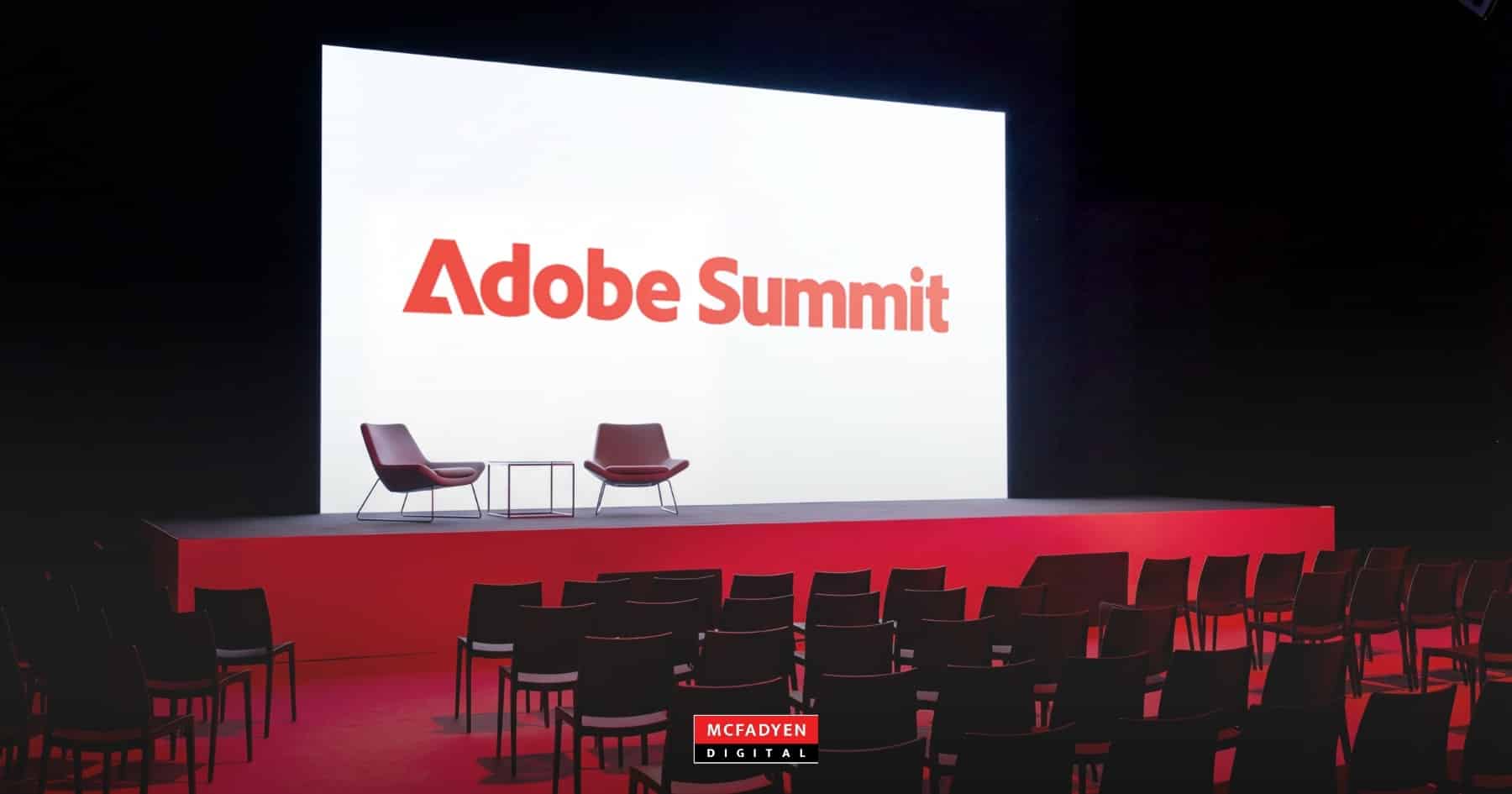
Adobe Summit 2026 is not a product launch event. It’s a signal.
Across more than 200 sessions, Adobe is making a coherent argument: the operating model for digital commerce is being rebuilt around AI. Not AI as a feature—AI as the layer through which customers discover products, brands make decisions, and platforms optimize themselves.
That’s a bigger shift than it sounds. And most commerce teams aren’t ready for it.
Here are the six themes we’re paying closest attention to at Summit and the specific implications for organizations running serious commerce operations.
1. The Front Door to Commerce Is Moving
For the past decade, “discovery” meant Google, a marketplace search bar, or your onsite search. Customers typed what they wanted and got a list of links.
That model is eroding fast. Adobe’s sessions make clear that AI assistants and conversational interfaces are becoming the first place customers encounter products and brands—before they ever land on a site.
The implications are significant. If a customer asks an AI assistant for recommendations on industrial fasteners, the answer they get is shaped by how well your product data is structured, how clearly your brand is represented in the AI’s training and retrieval sources, and whether your content was built to be understood by a machine, not just a human.
In 2026, ecommerce conversion isn’t just a site problem. It’s an answer-layer problem.
Key Session: The New Front Door to Commerce is AI. Are You Ready? [S303]
Further Reading: Brand Visibility in the Age of AI
2. SEO Has a New Discipline Attached to It
Adobe is framing this as the shift to an “Agentic Web”—a world where AI systems mediate brand discovery and selection, not just surface links.
Adobe’s LLM Optimizer is a direct response to this. The tool is designed to improve how brands are represented in generative AI search environments, recognizing that traditional keyword ranking is only part of the discoverability equation now.
The underlying discipline here is what practitioners are calling Generative Engine Optimization (GEO) and Answer Engine Optimization (AEO). The goal isn’t to game a new algorithm. It’s to make your brand legible and trustworthy to AI systems—through structured data, rich product attributes, entity-level brand signals, and content built for machine comprehension, not just human readers.
If your SEO strategy hasn’t started grappling with this yet, it’s already behind.
Key Session: Clicks to Visibility: How General Motors Builds Brand Presence in AI Search
Further Reading: Understanding Adobe LLM Optimizer
3. AI Agents Are Entering Commerce Architecture
The most technically substantive theme at Summit involves agent orchestration—specifically, Adobe’s Experience Platform Agent Orchestrator and related AI services.
This isn’t chatbots. It’s AI systems that can assist customers conversationally, automate marketing workflows, trigger personalization decisions, and coordinate across a customer data platform—without manual intervention at each step.
The challenge for commerce organizations isn’t access to these capabilities. It’s governance. As AI agents move from pilot to production, teams need clear answers to questions they haven’t had to ask before: How are agents authorized to act? How are their decisions logged and audited? What happens when an agent does something unexpected?
This is where experimentation gets serious—and where most organizations are going to feel the gap between their AI ambitions and their operational infrastructure.
Key Session: Agent Orchestrator Unpacked: The Tech Powering Agentic Customer Experiences [S602]
Further Reading: Why B2B is the Next Frontier for Agentic
SEE IT IN PRACTICE: VIRTUAL WEBINAR WITH MIDDLEBY
Unified Commerce for Manufacturers: One Platform, Many Brands
Middleby Corporation is a global manufacturer of commercial kitchen equipment with dozens of brands operating under one roof. Their Adobe Commerce implementation – Middleby Shop – is a live example of what production-grade unified commerce architecture actually looks like: multiple brands, one platform, dealer and distributor channels intact and B2B buyers able to research, quote and configure complete kitchen solutions across product lines.
McFadyen Digital’s Head of Strategy joins Middleby’s Vice President of Digital Commerce to walk through how they built and what it took to balance direct engagement with channel enable without creating conflict.
Session: Unified Commerce for Manufacturers: One Platform, Many Brands [OS758]
4. Experimentation Is Getting Automated
Adobe’s Summit sessions on AI-driven experimentation signal a real shift in how optimization works. Instead of teams manually designing every test, AI can identify what to test, generate hypotheses, and adjust experiences dynamically based on what’s working.
That’s powerful—but it raises a governance problem that tends to get glossed over in the demo. If AI is running your optimization backlog, who’s accountable for the decisions? How do you maintain transparency when the test design itself is automated?
The teams that will get the most out of this aren’t the ones that turn AI loose on their experimentation program and wait. They’re the ones who build a well-prioritized backlog of measurable outcomes first, then use AI to accelerate the path to answers. The technology is a multiplier. You still need to know what you’re measuring.
Key Session: The Future of Experimentation: How Agentic AI is Fueling Smarter Growth [S523]
Further Reading: B2B Buying Maze: Why Complexity is Your Biggest Risk
5. Analytics Is Shifting From Reporting to Acting
Adobe’s Data Insights Agent is positioned to let more people across an organization explore experience data without requiring deep analytics expertise. The goal: faster time from insight to action.
For commerce teams, that’s useful—but only if the underlying data model is clean. AI-assisted analytics surfaces patterns faster, but it can’t compensate for disconnected data across content, customer journey, and conversion outcomes. The organizations that benefit most will be the ones that have already done the boring work of tightening their measurement architecture.
More tools for data exploration don’t fix fragmented data. They just make the fragmentation more visible.
Key Session: How Adobe AI Drives Speed to Insight [S109]
Further Reading: Buyers are Everywhere. You Can See Almost None of It.
6. Performance Is Still Foundational—and Now It’s Compounding
Edge Delivery Services and storefront performance remain core Summit themes, and they deserve more attention than they usually get from commerce leaders who are focused on AI.
Speed doesn’t just affect Core Web Vitals anymore. It affects AI crawlability, personalization responsiveness, discoverability in AI-mediated environments, and conversion across every channel simultaneously. A fast experience is a better experience for human users, search engines, and AI assistants alike.
In that sense, performance investment has become compounding. Improvements don’t improve one channel—they improve all of them at once. That’s a different way to think about the ROI of edge delivery.
Key Session: Skill Exchange: Accelerating Adobe Commerce Storefront Performance [S906]
Further Reading: The Future of Scalable, Intelligent Commerce
The Through Line
The common thread across all six of these themes is the same: commerce is moving toward an AI-native operating model. Discovery, optimization, experimentation, analytics, and platform architecture are all being rebuilt around AI systems that can act, learn, and orchestrate—not just assist.
The difference between the brands that come out ahead and the ones that fall behind won’t be access to tools. Adobe’s tools will be available to everyone. The difference will be organizational readiness—the ability to move from experimentation to operational systems, with the right data, governance, and measurement infrastructure in place to make AI work at scale.
That’s the question every commerce leader should be asking coming out of Summit. Not “Which AI tools should we pilot?” but “How ready are we to operationalize them?”
Say hello at Adobe Summit 2026
We’re at Summit this week. If any of these themes are live conversations in your organization — AI discovery, channel architecture, unified commerce — we’d welcome a direct conversation. Reach out here.
Related Articles


Turn Insight Into Impact.
Start Today.