Written by: Jeff Mikos
Reading time: 8 minutes
Updated: 03/10/2026
Published: 02/19/2026
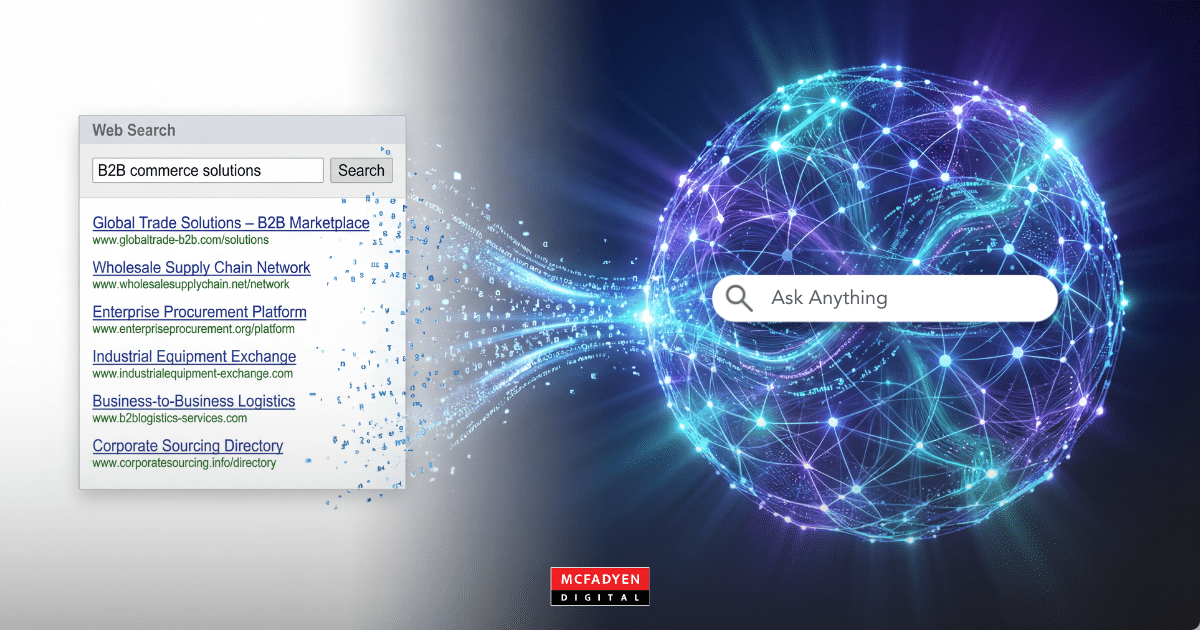
The way buyers discover brands has fundamentally changed. Traditional search engine optimization focused on ranking in the coveted “top 10 blue links” on Google. Today, AI-powered answer engines like ChatGPT, Perplexity, Google AI Overviews, and Microsoft Copilot synthesize information from across the web and present it as direct answers, often without requiring users to click through to any website at all.
The implications are stark: research shows that approximately 60% of Google searches now end without a click, and Gartner predicts that by 2026, 25% of organic search traffic will shift to AI chatbots and virtual assistants. For B2B distributors, manufacturers, and commerce brands, this creates a new strategic imperative: it’s no longer enough to rank well. You must be cited, mentioned, and recommended by AI systems.
This shift requires a new understanding of brand visibility and an entirely different optimization playbook. Let’s break down what brand visibility means in this AI-first world, why it matters for your business, and what strategies actually work.
What Is Brand Visibility in AI-Powered Search?
Brand visibility in the context of AI-powered search refers to how frequently, accurately, and favorably your brand appears in AI-generated answers, summaries, and recommendations. Unlike traditional SEO where visibility meant your page ranking in search results, AI visibility is measured by whether large language models cite your content when answering relevant questions.
This encompasses several dimensions:
- Citation frequency: How often AI engines reference your domain or brand when responding to queries in your domain of expertise. Studies show that LLMs typically cite only 2-7 domains per response, far fewer than Google’s traditional 10 results. Being one of those few cited sources is critical.
- Attribution accuracy: Whether AI systems correctly represent your products, services, and expertise. Misattribution or factual errors in AI-generated content can be more damaging than not being mentioned at all.
- Sentiment and positioning: The tone and context in which your brand appears. Are you positioned as a leader, an alternative, or merely mentioned alongside competitors? Is the sentiment positive, neutral, or negative?
- Entity recognition: How well AI systems understand your brand’s relationships to products, industries, locations, and expertise areas. Strong entity recognition helps AI engines connect your brand to relevant queries across topics.
The shift from traditional search to AI-mediated discovery represents more than a technical change. It’s a fundamental restructuring of how information flows from brands to buyers. Where Google historically presented choices, AI engines increasingly make recommendations. This compression of the decision journey puts enormous pressure on being visible at the moment of synthesis.
Why Brand Visibility Matters More Than Ever
For mid-market and enterprise B2B organizations, declining AI visibility isn’t just a marketing metric problem. It’s a revenue risk.
1. Zero-Click Search Is the New Normal
Approximately 80% of consumers now rely on zero-click results, meaning they get their answer without visiting any website. If your brand isn’t cited in that answer, you’ve lost the opportunity entirely. There’s no second chance through improved click-through rates or better meta descriptions.
For B2B commerce, this matters acutely during early-stage research. When a procurement professional asks ChatGPT “what are the leading industrial valve manufacturers for high-pressure applications,” being excluded from that answer means you’re out of consideration before traditional demand generation even begins.
2. AI-Referred Traffic Is Growing Rapidly
AI-referred sessions have jumped 527% between January and May 2025, according to recent analytics data. ChatGPT alone receives over 4.5 billion monthly visits, and Perplexity processes more than 500 million searches per month. These platforms are no longer experimental; they’re mainstream discovery channels.
Organizations that have optimized for AI visibility are seeing measurable traffic gains from these referrals, while those that haven’t are watching competitors capture share. The compounding effect is significant because AI engines reinforce their own citations. Once a brand becomes established as an authoritative source on a topic, it tends to be cited more frequently, creating a virtuous cycle.
3. Traditional SEO Doesn’t Guarantee AI Visibility
Many organizations are experiencing declining organic traffic despite stable or even improved traditional SEO performance. The disconnect stems from the fact that AI engines prioritize different signals than traditional search algorithms.
While Google’s algorithm weighs backlinks, domain authority, and keyword optimization heavily, AI engines prioritize content extractability, structured data, factual consistency across sources, and authoritative citations. A page optimized for human readers and traditional search may be functionally invisible to AI systems if it lacks proper schema markup or buries answers in long-form narrative content.
4. The Competitive Landscape Is Shifting Fast
Early movers in AI optimization are establishing positions that will be difficult to displace. Because AI engines learn from patterns across the web, brands that consistently appear as authoritative sources reinforce their own visibility. Organizations that wait risk finding their competitors already entrenched in AI responses, requiring significantly more effort to break through.
Core Strategies for Optimizing Brand Visibility
Optimizing for AI visibility requires a multi-dimensional approach that combines content strategy, technical implementation, and authority building. The most effective programs address all three.
Strategy 1: Implement Comprehensive Structured Data
Structured data using Schema.org vocabulary is the foundation of AI visibility. Research indicates that 81% of web pages cited by AI engines include schema markup. This isn’t coincidence. Schema provides AI systems with explicit signals about what your content contains, who created it, when it was published, and how it relates to other entities.
Critical schema types for B2B commerce include:
- Organization schema: Establishes your brand identity, relationships, and expertise areas. This helps AI engines understand who you are and what you’re known for across queries.
- Product schema: Provides explicit product specifications, pricing, availability, and review information in machine-readable format. AI engines can extract and compare this data across vendors.
- FAQ schema: Surfaces questions and answers directly to AI systems in the exact format they need for synthesis. This dramatically improves citation rates for question-based queries.
- HowTo schema: Breaks down processes into clear steps, making your expertise more extractable for AI engines generating instructional content.
- Article schema: Identifies authoritative content with publication dates, authors, and topics. Platforms like Perplexity show preference for properly marked up articles when citing sources.
Implementation must be comprehensive and validated. Incomplete or incorrect schema markup can be worse than none at all, as it may cause AI systems to extract wrong information or skip your content entirely.
Strategy 2: Adopt Answer-First Content Architecture
AI engines excel at extracting clear, direct answers from content. Traditional marketing content that buries key information in storytelling or requires multiple paragraphs before reaching the point performs poorly in AI synthesis.
Answer-first content architecture restructures information to put conclusions, specifications, and key facts at the top, with supporting detail following. This pattern mirrors how AI engines parse and extract content. Research from Princeton shows that optimized content using citations, statistics, and quotations can improve AI visibility by 30-40% compared to unoptimized content.
Key implementation tactics include:
- Hub-and-spoke content models: Create comprehensive pillar pages on core topics, surrounded by detailed spoke content addressing specific subtopics. This builds topical authority and helps AI engines understand your expertise depth.
- Expanded FAQ content: Systematically answer the questions your audience asks, using natural language that matches query patterns. AI engines frequently extract from FAQ sections because the question-answer format is inherently extractable.
- Citation-worthy assets: Develop content that other sources want to cite, such as original research, proprietary data, expert analysis, and industry benchmarks. Being cited by other authoritative sources signals to AI engines that your content is trustworthy.
- Multimodal optimization: Include properly tagged images, charts, and diagrams with descriptive alt text and captions. As AI engines expand multimodal capabilities, visual content with strong metadata becomes increasingly important.
Strategy 3: Build and Signal Authority (E-E-A-T)
Google’s E-E-A-T framework (Experience, Expertise, Authoritativeness, Trustworthiness) has become equally critical for AI visibility. AI engines actively evaluate whether sources are credible before citing them. This evaluation happens through both explicit signals (author credentials, publication history) and implicit signals (consensus across multiple sources, citation patterns).
Authority building strategies include:
- Author credential optimization: Ensure that content creators have visible credentials, bios, and expertise signals. AI engines look for signals that content comes from qualified sources.
- Consensus building: Ensure consistent information across your owned properties (website, blog, documentation, support content). Inconsistencies across channels signal unreliability to AI systems.
- Citation generation: Actively work to be cited by authoritative third-party sources through thought leadership, industry publication contributions, and strategic PR. Being cited by trusted sources creates a citation cascade effect.
- Information gain: Create content that adds unique value through original research, proprietary insights, or expert perspective. AI engines prioritize sources that offer information not available elsewhere.
Strategy 4: Optimize Technical Infrastructure for AI Crawlability
AI engines must be able to access and parse your content efficiently. Technical barriers that might not significantly impact traditional SEO can completely block AI visibility.
Critical technical optimizations include:
- Server-side rendering: Ensure critical content is available in initial HTML, not hidden behind JavaScript execution. Many AI crawlers have limited JavaScript rendering capabilities.
- Page speed optimization: AI crawlers often have strict timeout limits. Pages that load slowly may be skipped entirely or only partially indexed.
- Mobile-first design: AI engines increasingly prioritize mobile-optimized content. Responsive design and mobile performance are table stakes.
- Content freshness: Regularly updated content signals ongoing relevance. Establish content refresh cadences for core pages, particularly for time-sensitive topics like product specifications and industry trends.
Strategy 5: Establish Comprehensive Measurement and Monitoring
You can’t optimize what you can’t measure. Effective AI visibility programs require robust measurement frameworks that go beyond traditional SEO analytics.
Critical metrics to track include:
- AI share of voice: What percentage of relevant AI answers mention your brand versus competitors? This reveals your relative visibility across the AI landscape.
- URL citation rate: How frequently do AI engines link to your domain when citing information? This indicates both visibility and trust.
- Entity correctness: How accurately do AI engines represent your brand, products, and expertise? Regular audits can catch misattributions before they compound.
- Time to citation: How quickly does new content get picked up by AI engines? Faster indexing indicates strong domain authority.
- AI-referred traffic and conversion: Track visitors arriving from AI platforms through attribution in Google Analytics 4. Monitor both volume and quality of this traffic.
Advanced programs also track competitive displacement (instances where you replace competitors in AI answers) and sentiment scoring (the tone of brand mentions).
Getting Started: A Pragmatic Roadmap
For most mid-market and enterprise B2B organizations, optimizing for AI visibility is a multi-quarter journey requiring cross-functional coordination between marketing, content, IT, and data teams. The most successful approaches follow a phased roadmap.
Phase 1: Assessment and Baseline (Weeks 1-4)
Begin with a comprehensive audit of your current AI visibility across major platforms including ChatGPT, Perplexity, Google AI Overviews, and Microsoft Copilot. Test queries relevant to your products, services, and expertise areas. Document where you appear, where competitors appear instead, and where the AI provides generic answers without citing anyone.
Simultaneously assess your content’s machine readability. Review what percentage of your pages include proper schema markup. Evaluate whether critical content is buried in JavaScript or immediately available in HTML. Test page load speeds and mobile performance. This technical assessment reveals your baseline crawlability.
Phase 2: Quick Wins and Foundation Building (Weeks 5-12)
Focus initial implementation on high-value, high-visibility pages. Implement schema markup on your homepage, key product pages, and top-performing blog content. Restructure FAQ pages with proper schema and answer-first formatting. These quick wins often yield measurable visibility improvements within weeks.
Simultaneously establish your measurement framework. Set up tracking for AI-referred traffic in Google Analytics 4. Begin systematic monitoring of brand mentions across AI platforms. Create competitive benchmarks so you can track relative performance over time.
Phase 3: Systematic Optimization (Months 4-6)
Expand schema implementation across your entire content library. Develop content templates and guidelines that embed answer-first architecture and schema markup into your publishing workflow. This ensures new content is optimized by default rather than requiring retroactive fixes.
Address technical infrastructure gaps identified in your initial assessment. Implement server-side rendering for key content. Optimize page speed. Ensure mobile performance meets standards. These technical improvements create the foundation for sustained visibility.
Phase 4: Authority Building and Continuous Optimization (Ongoing)
Shift focus to building long-term authority through consistent content quality, strategic citation generation, and ongoing monitoring. Develop processes for regular content updates to maintain freshness. Track platform evolution and adapt strategies as AI engines change their citation patterns.
The most successful organizations treat AI visibility as a durable capability rather than a one-time project. They integrate optimization into their regular content operations, establish cross-functional governance, and continuously refine based on performance data.
The Strategic Imperative
Brand visibility in AI-powered search is not a future consideration. It’s a present reality reshaping how buyers discover, evaluate, and select vendors. Organizations that recognize this shift and invest in systematic optimization are capturing mindshare and market share. Those that wait risk finding themselves systematically excluded from the conversations that matter most.
The good news is that AI visibility optimization builds on existing digital commerce fundamentals. Organizations with strong content strategies, solid technical foundations, and disciplined measurement practices can adapt their capabilities to this new paradigm. The transition requires investment and expertise, but the path forward is clear.
For mid-market distributors and manufacturers, the question isn’t whether to optimize for AI visibility but rather how quickly you can establish the capabilities to compete effectively in this new landscape. Your competitors are already asking that question. The time to act is now.
McFadyen Digital helps mid-market and enterprise B2B organizations develop comprehensive strategies for AI visibility and Generative Engine Optimization. Our approach combines content strategy, structured data implementation, technical optimization, and measurement frameworks tailored to complex, multi-brand digital ecosystems. If you’re ready to ensure your brand is discovered and cited by AI-powered search, let’s talk.
Related Articles



Turn Insight Into Impact.
Start Today.