
Written by: Jeff Mikos
Reading time: 3 minutes
Updated: 08/06/2026
Published: 08/06/2026
There is a name for what most B2B distributors are doing with AI right now. They are touring it.
They attend the demos. They run the proofs of concept. They put “AI initiatives” in the investor deck and they buy the tools. By every measure that shows up in a board update, adoption is universal. Then everyone goes back to work exactly as before.
That is AI tourism. It feels like progress because it involves the right technology and the right language. It does not produce results, because nothing underneath actually changes.
And it is not cheap. In a 2026 benchmark of AI in B2B commerce, only 17% of deployments reported a significant return. Forty-eight percent called their results merely “somewhat effective.” MIT studied roughly 300 enterprise generative-AI deployments and found about 95% delivered no measurable business result. The cause was not the models. It was brittle workflows and poor operational fit.
Why distribution is one of the hardest places to make AI pay
This is not a failure of ambition. It is the predictable result of investing in AI tools without changing the infrastructure, workflows, and operating practices those tools depend on.
Distribution makes that harder than almost anywhere else, for reasons that have nothing to do with ambition and everything to do with structure. A typical mid-market distributor runs a catalog of tens or hundreds of thousands of SKUs with attributes of uneven quality. Pricing is ERP-dependent and layered with customer-specific contracts, rebates, and tiers. Sales is relationship-heavy and spread across branches, field reps, and inside teams. A workflow change does not stay in one place. It ripples across branches, plants, sales teams, customers, and channel partners.
Those same complexities are exactly what make AI valuable here, and exactly what make it hard to deploy. It is no accident that the most-cited barrier to scaling AI in B2B is legacy-system integration, ahead of data privacy and sales-team resistance. Running a proof of concept sidesteps the hard integration work. Building a working operating capability requires it.
Here is the thesis, stated plainly. Operational AI does not fail in distribution because the AI is weak. It fails because the commerce layer it depends on is not ready. That is the connective tissue between product data, ERP, contract pricing, the digital storefront, customer behavior, and the workflows that turn a recommendation into an order.
Our 2026 study of the 37 largest North American distributors makes the failure mode visible. Sixty-two percent scored well on B2B workflow support, contract pricing, quick order, quoting, punchout, vendor-managed inventory. These are largely solved. Yet only 14% scored well on AI-assistant presence. The industry has digitized its transactions without digitizing its judgment. The systems can take an order. They cannot yet help a customer decide what to order.
As the study put it: a distributor does not need a chatbot. It needs an AI buying layer that understands its products, customers, pricing, inventory, contracts, and purchasing workflows. The gap is not in AI technology. It is in connecting AI to the commerce workflow.
This is why the biggest measured gains in the study did not come from chat windows at all. They came from embedded, often invisible features. Personalization. Proactive reorder. Recommendations. Assisted quoting at the quote-to-order seam, where margin and sales capacity are won or lost every day. The buyer never sees the model. They just experience a better way to buy.
What operators do that tourists do not
The distributors who move past tourism do not buy more AI. They build the commerce infrastructure, redesign the workflows around it, right-size governance so a mid-market team can actually move, and measure value in business terms rather than logins and seats activated. They treat it as one connected system, because each part fails without the others.
None of that requires a Fortune 100 transformation office. It requires knowing where your commerce layer stands today, choosing one or two use cases pointed directly at margin, capacity, or retention, and deciding in advance what number would make you kill a pilot. That last discipline is what makes the next pilot fundable.
Where to start
The demand side is not waiting. Gartner projects that by 2028, 90% of B2B buying transactions will be handled by AI agents, intermediating more than $15 trillion in spend, and buyers are already pulling in that direction: 67% now prefer a rep-free buying experience, up from 33% in 2020. The distributors whose product data and commerce workflows are connected and agent-ready will meet that demand on their terms. The gap between them and everyone else grows every quarter they stay ahead.
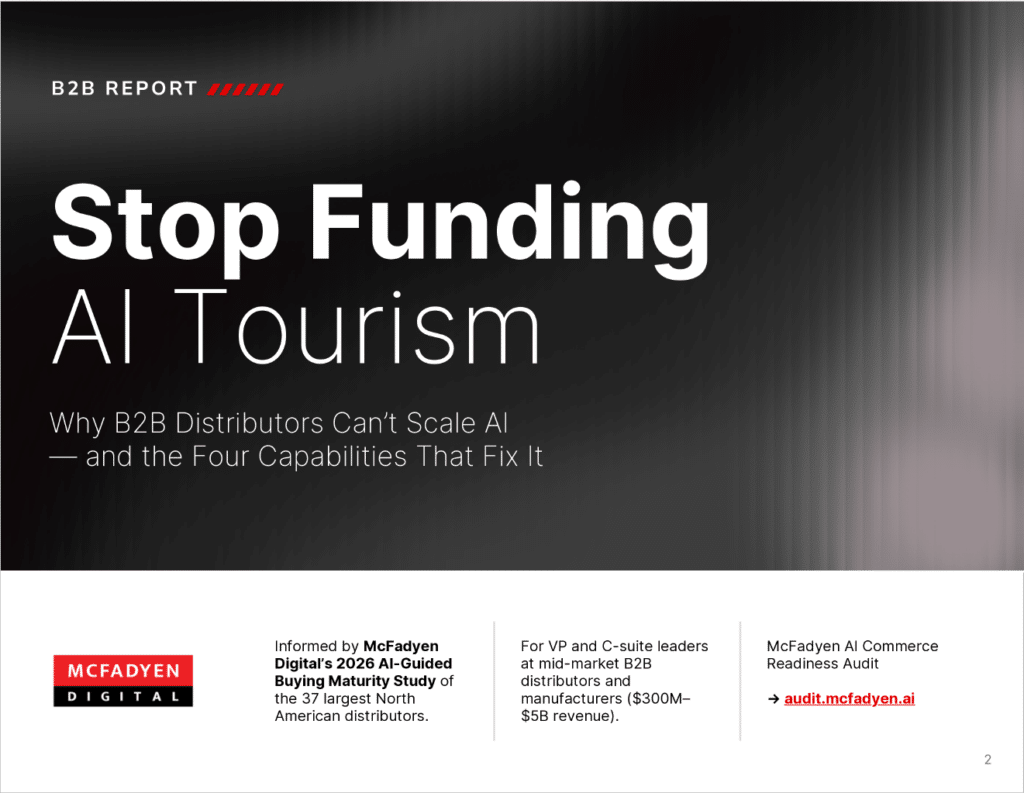
We put the full argument, the four capabilities, the 90 to 180 day sprint, and a value scorecard into one report.
Stop Funding AI Tourism eBook
Related Articles


Turn Insight Into Impact.
Start Today.