Written by: Jeff Mikos
Reading time: 6 minutes
Updated: 10/13/2026
Published: 07/09/2026
TL;DR: A foodservice distributor’s advantage is moving from the warehouse to its data and integrations. Five trends are driving that shift in 2026: dropship “endless aisle” marketplaces, real-time APIs replacing batch EDI, AI personalization on the distributor’s own ordering platform, AEO and GEO to get onto AI shortlists, and e-commerce penetration as the scoreboard. All five depend on product data quality and integration depth.
For most of the last sixty years, a foodservice distributor’s edge lived in its warehouse: how much inventory it could hold, how fast its trucks could move it. That is no longer where the advantage gets built. The distributors pulling ahead right now are winning somewhere else entirely, in their data, their integrations, and whether an AI system can find them in the first place.
That shift has a name: platform economics. Instead of growing by adding warehouse capacity, the fastest growing distributors are decoupling revenue from square footage, using dropship networks, modern integrations, and AI systems to sell far more than they physically hold. Five specific technology shifts are driving that change in 2026. None of them are hypothetical. All five are already running in production at real foodservice distributors.
1. Endless Aisles and Dropship Marketplaces
Foodservice operators want more variety than any single warehouse can stock, and the physical economics of cold chain make that expensive to solve with inventory alone. The answer distributors are converging on is the dropship marketplace, sometimes called a virtual warehouse: a catalog of items that ship directly from suppliers to operators without ever touching the distributor’s own dock.
Gordon Food Service built one of the earliest versions of this model, integrating a drop-ship program directly into its broadline e-commerce platform and its Gordon Now ordering app. Its virtual warehouse has grown past 50,000 products and recently expanded into Canada. None of that inventory sits in a Gordon Food Service warehouse. All of it is listed, ordered, and fulfilled through a marketplace layer built on top of the core distribution business.
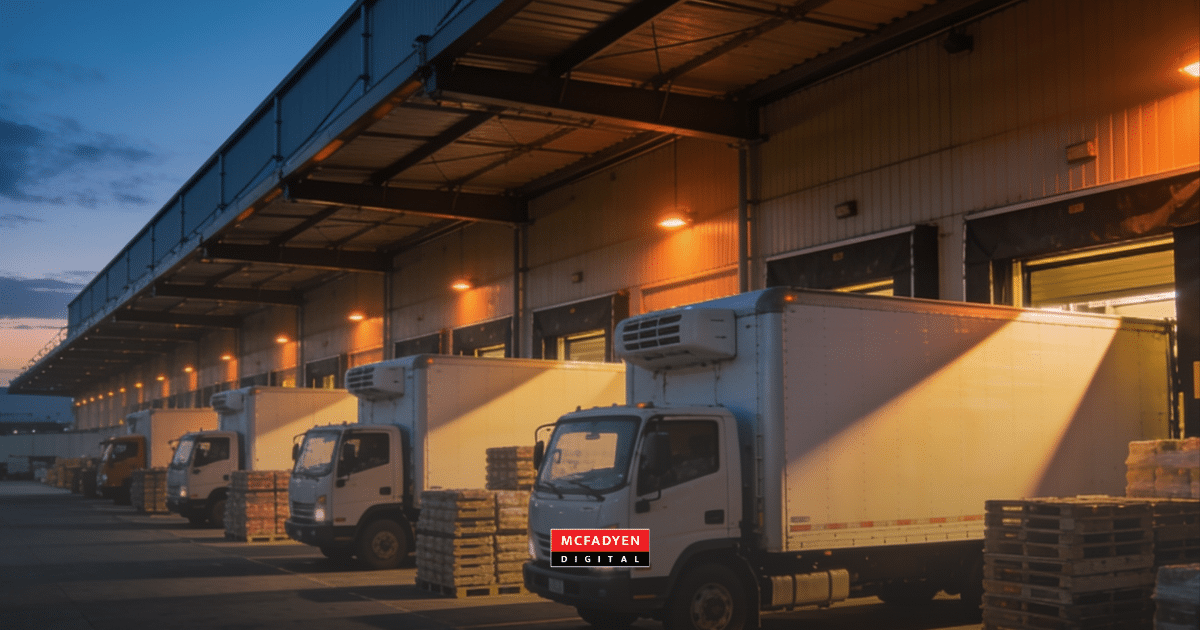
That model is not evenly distributed across the catalog. Dropship overwhelmingly works for ambient, shelf-stable product, because a parcel carrier cannot hold the cold chain custody a distributor’s own reefer fleet can. Frozen proteins and refrigerated dairy still move through broadline trucks, not a marketplace listing, which is exactly why endless aisle complements a distributor’s core temperature-controlled business instead of replacing it.
The tradeoff is real. A dropship catalog only works if the underlying product data is accurate enough that an operator can order confidently without calling a rep, and if checkout blends broadline and drop-ship items into one order instead of two. Get the data or the checkout wrong, and an endless aisle turns into an endless queue of customer service tickets.
2. Modern APIs Are Replacing Legacy EDI
Dropship only works at scale if a distributor’s systems can talk to dozens or hundreds of suppliers without a developer manually mapping each connection. That has traditionally meant EDI: batch file exchanges on a fixed schedule, built for a world where next day was fast enough.
Next day is no longer fast enough. A newer generation of API first integration platforms, Flxpoint among them, now offers real time, request response connections instead of batch files, with hundreds of pre-built supplier integrations available out of the box. The practical difference: real time inventory sync that prevents overselling a product a supplier already ran out of, instead of finding out a day later.
That gap is not evenly distributed either. A batch delay on a case of napkins is an inconvenience. The same delay on a product with a three day shelf life is a write-off.
Regulation is pushing in the same direction. FSMA 204, the FDA’s food traceability rule, requires Key Data Elements and Critical Tracking Events at the lot level for foods on the Food Traceability List. The FDA pushed its enforcement deadline back 30 months, to July 2028, but the commercial pressure did not move with it. Distributors and retailers are already writing lot-level traceability requirements into supplier contracts ahead of that deadline, and batch EDI, built for SKU-level data on a fixed schedule, was never designed to carry that granularity.
This is the least visible of the five trends, and the one most likely to determine whether the other four actually work. Endless aisle, personalization, and AI discoverability all depend on data moving in real time. A distributor still running its core supplier connections on EDI batch files is building the other four trends on top of a foundation that cannot support them.
3. AI-Driven Personalization on the Distributor’s Own Platform
Sysco’s ordering platform, Sysco Shop, layers AI on top of every customer’s order history and behavioral data pulled from Salesforce and Tealium. The system tailors product recommendations by operator type, so a steakhouse and a sandwich shop see different suggestions after logging in. It flags anomalies in purchasing patterns, predicts which customers are likely to try a new product, and surfaces next best action prompts to sales reps ahead of account calls.
That matters more in a business built on field sales than it would elsewhere. A distributor sales rep is often the sole point of contact for an independent account, paid on total sales and gross margin, covering dozens of accounts across a territory. No rep can manually track purchasing patterns at that scale. An algorithm can.
The result Sysco reported in 2024: 450 million dollars in incremental sales over roughly three years of the personalization program. That is not a claim about AI in the abstract. It is a specific workflow, tied to a specific data source, with a specific business result attached.
That distinction is the whole point. Practical AI in foodservice distribution looks like this: a defined use case, a named workflow, and a measurable outcome. Anything short of that is a chatbot demo, not a commerce capability.
4. AEO and GEO: Winning the AI Procurement Shortlist
A newer discovery channel is emerging alongside search, and most distributors are not positioned for it yet. Answer Engine Optimization, or AEO, is the practice of structuring product and company content so an AI system can extract it and cite it directly inside a generated answer. Generative Engine Optimization, or GEO, is the broader strategy behind that: owning a brand’s presence across the entire AI-mediated research process, not just a single query.
Across B2B buying more broadly, 51 percent of buyers now say they start vendor research inside an AI chatbot rather than a search engine, up from 29 percent as recently as April 2025. Sixty three percent of AI-generated shortlists contain only two or three vendors. If a distributor’s catalog and content are not structured well enough for an AI system to cite, that distributor is not on the shortlist. It does not get a chance to lose the deal. It never enters it.
For a foodservice distributor, that means structuring more than price and SKU. An AI procurement agent evaluating a distributor’s catalog needs temperature requirement, shelf life, case pack, and lot data structured well enough to cite, not buried in a PDF spec sheet or a rep’s head.
Foodservice distribution has not caught up to this shift yet, and that is the opportunity. The distributors treating AEO as core commerce infrastructure now, not a marketing afterthought later, will be the ones whose catalogs AI procurement agents are actually citing in 2027.
5. E-Commerce Penetration Is the Scoreboard
Every trend above rolls up into one number. North America’s FMCG B2B e-commerce market is projected to grow from 1.73 trillion dollars in 2025 to 2.95 trillion dollars by 2030, with foodservice operators the largest buyer segment at 55% of the market in 2025 (Mordor Intelligence, 2026).
That growth will not be evenly distributed. It will concentrate in the distributors executing on the four trends above: accurate product data, real time integrations, AI personalization, and AI discoverability. E-commerce penetration is not a separate initiative to run alongside those four trends. It is the measurement of how well they are working together.
Where This Leaves Foodservice Distributors
These five shifts are not five separate bets. They are one bet: that data quality and integration depth determine whether a distributor can be found, evaluated, and chosen, whether that happens on a shelf, inside a marketplace, or inside an AI agent’s shortlist.
Foodservice distributors spent the last decade competing on assortment and delivery speed. The next few years will be decided by something less visible: whether the systems underneath that assortment can keep up with how buying decisions actually get made now.
McFadyen Digital built the McFadyen AI Commerce Readiness Audit to measure exactly this, across catalog data quality, integration depth, and AI discoverability. It takes about ten minutes and gives a foodservice distributor a specific picture of where it stands against the five trends above.
Take the audit at audit.mcfadyen.ai.
Frequently Asked Questions
What technology trends are reshaping foodservice distribution in 2026?
Five: endless aisles and dropship marketplaces; modern APIs replacing legacy EDI; AI-driven personalization on the distributor’s own platform; AEO and GEO for winning AI procurement shortlists; and e-commerce penetration, which measures how well the other four are working together.
What is a dropship marketplace or virtual warehouse in foodservice?
It’s a catalog of items that ship directly from suppliers to operators without touching the distributor’s own dock. Gordon Food Service’s virtual warehouse has grown past 50,000 products. It works best for ambient, shelf-stable products, so it complements a distributor’s cold-chain business rather than replacing it.
Why are foodservice distributors replacing EDI with APIs?
Batch EDI runs on a fixed schedule, so inventory updates arrive late, which is costly for products with a three-day shelf life. Real-time API connections prevent overselling, and the lot-level traceability FSMA 204 requires is more granular than batch EDI was designed to carry.
When is the FSMA 204 compliance deadline?
The FDA pushed enforcement of FSMA 204 back 30 months, to July 2028. Distributors and retailers are already writing lot-level traceability requirements into supplier contracts ahead of that deadline.
What are AEO and GEO for distributors?
Answer engine optimization (AEO) structures product and company content so AI systems can extract and cite it. Generative engine optimization (GEO) is the broader strategy for a brand’s presence across AI-driven research. For a foodservice distributor, that means structuring temperature requirements, shelf life, case pack and lot data so AI procurement agents can cite it, instead of leaving it in PDF spec sheets.
Why does product data quality matter so much for foodservice distributors?
All five trends depend on it. A dropship catalog only works if operators can order confidently without calling a rep, and AI procurement agents can only shortlist a distributor whose product facts are structured well enough to cite. Weak data turns an endless aisle into a queue of customer service tickets.
Related Articles

Turn Insight Into Impact.
Start Today.