Written by: th1@g0_cruz
Reading time: 6 minutes
Updated: 11/16/2026
Published: 11/16/2026
In short: PHP vulnerabilities for commerce sites are fixed in PHP releases, not in your platform patches. Patching Magento or Adobe Commerce does not update the PHP runtime underneath it. PHP2Shell, two critical flaws that CISA lists as exploited, is a recent example. Name an owner for every PHP system, keep PHP on a supported version, and get patch dates in writing.
A store running the latest Magento or Adobe Commerce security patches may still be vulnerable if the underlying PHP runtime hasn’t been updated. PHP2Shell, disclosed in October 2026, is a recent example. The fixes have been available since October 21, and CISA has confirmed active exploitation. But the question is no longer whether a fix is available. It’s whether your organization has applied it, verified it in production, and knows who’s responsible for keeping PHP current. That question applies to every PHP security release, not only this one.
Your Commerce Platform Runs on PHP
Most commerce platforms that distributors, manufacturers, and retailers rely on run on PHP: Magento Open Source, Adobe Commerce, WooCommerce, Shopware, PrestaShop, and OpenCart among them. That is why PHP vulnerabilities for commerce sites get attention fast.
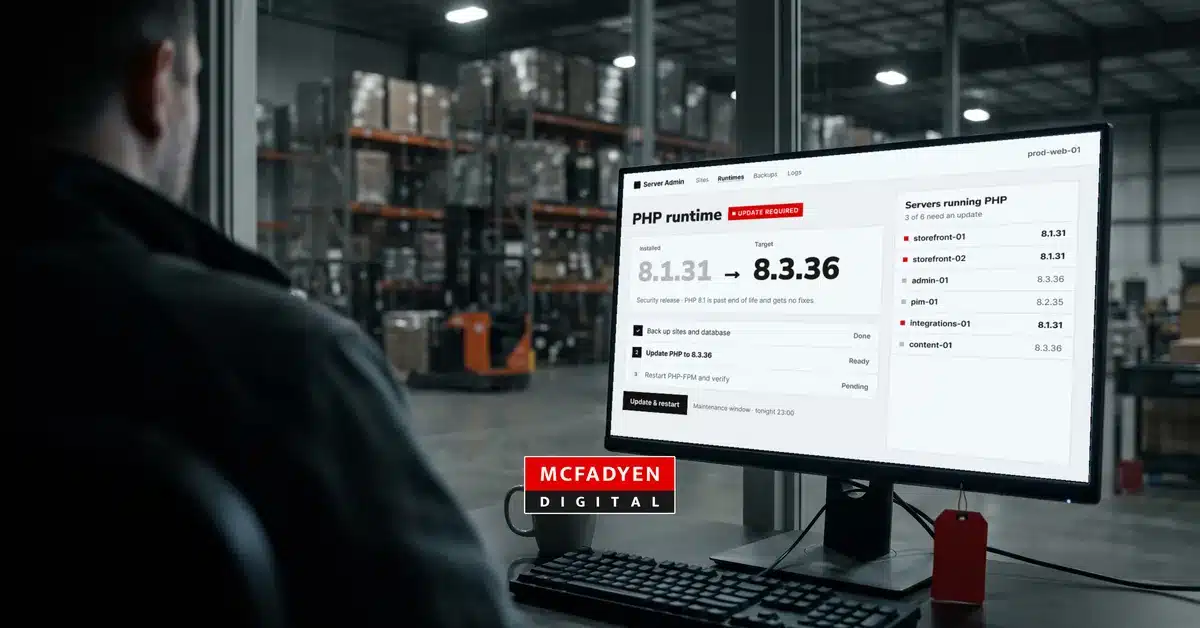
Your platform vendor patches its own code. PHP is a separate component with its own releases, and it changes only when someone updates it and restarts the service. The storefront is also rarely your only PHP system: a PIM, a content site, an integration service, or an internal admin tool may run on PHP too.
Why PHP Needs Its Own Patch Process
A platform security patch and a PHP update fix different problems, and you need both. The PHP project publishes security fixes as new PHP releases, and each release branch has a published end date for security support. PHP 8.2 stops receiving security fixes on December 31, 2026, and PHP 8.3 follows on December 31, 2027. PHP 8.1 and older no longer receive updates from the PHP project.
Your platform version can also decide how long your PHP stays supported. Under Adobe’s published requirements, each Magento and Adobe Commerce release runs only on specific PHP versions, so an older platform release can leave you on a PHP branch that no longer gets fixes.
PHP2Shell: A Recent Example, and How Worried to Be
Commerce is where your revenue, customer accounts, and contract pricing meet your ERP. PHP2Shell is two flaws, CVE-2026-109618 and CVE-2026-109619, that can let an attacker run code on a web server without logging in. Prioritize remediation now. Not enough to panic.
The flaws are in PHP itself, not in your store code. Researchers at Calif, a California-based security firm, confirmed the attack against Magento 2.4.9 without logging in.
| Question | Answer |
| How severe is it? | Critical, 9.2 out of 10. Unpatched PHP versions going back to 5.4 are affected. |
| Is it being exploited? | Yes. CISA added both flaws to its known-exploited list on October 26. |
| Is a fix available? | Yes, since October 21: PHP 8.5.12, 8.4.27, 8.3.36 or 8.2.35. |
| How widespread is it? | Palo Alto Networks counted more than 22 million internet-facing systems that could be exposed. |
| Will we need downtime? | Often not. Many teams can apply a PHP update and restart in a routine maintenance window. |
There is room to work. Rapid7 found that public exploits worked only against a narrow mix of operating system, PHP version, and web server. Configuration workarounds reduce the risk but do not remove it. Updating PHP is the only complete fix.
A third, related flaw, CVE-2026-115560, is a separate matter. The PHP project describes it as an unlikely route to code execution that needs an unusual configuration, and says it will publish a full advisory with its next regular release.
Who Owns the Fix Depends on How You Host
| How you run commerce | Who updates PHP | What to ask for |
| Self-hosted | Your team or your partner | Every PHP server on a patched version and restarted |
| Managed hosting | Your hosting provider | The patched version and the date applied, in writing |
| Adobe Commerce on cloud infrastructure | Shared between Adobe and you | A support case confirming the patched PHP image is live in production |
| SaaS (Shopify, BigCommerce, Adobe Commerce as a Cloud Service) | The platform | Nothing for the store; review any PHP apps you host separately |
For Adobe Commerce on cloud infrastructure, work with Adobe and your implementation partner to confirm that a patched PHP version is deployed and running in production. Validate compatibility with your Commerce version and extensions.
Not sure who owns PHP in your stack? Talk to our Adobe Commerce team.
Four Steps After Any PHP Security Release
1. Inventory every PHP system and name an owner. Storefront, admin, PIM, content sites, integrations, and internal tools.
2. Update PHP and restart it. The old version keeps running until the service reloads.
3. Get it in writing. For anything you do not patch yourself, ask for the version number and the date it went live.
4. Check for unusual activity. Review logs and file changes back to the earliest reported attacks, which can predate the fix, especially on systems patched late. For PHP2Shell, the earliest reported attempt was October 17, four days before public disclosure.
Make PHP Part of Your Patch Routine
PHP2Shell will not be the last PHP security release. A few habits make the next one routine:
- Keep one list of every PHP system, with an owner and the PHP version each one runs.
- Put PHP end-of-life dates on the same calendar as your platform’s support dates.
- After each PHP security release, ask hosts and partners to confirm the version in writing.
- Test PHP updates against your Commerce version and extensions in staging before an urgent one arrives.
On an Older Release? Start the Upgrade Conversation
PHP 8.1 did not get a patched release for PHP2Shell. Under Adobe’s published requirements, Magento and Adobe Commerce 2.4.4 and 2.4.5 are limited to PHP 8.1, while 2.4.6 and later can run a branch that has one. Some hosts have backported the fix into their own PHP 8.1 builds, which protects you in the short term only.
Even a supported PHP branch has an end date. PHP 8.2.35 patches PHP2Shell, but PHP 8.2 reaches end of life on December 31, 2026. If you run Adobe Commerce 2.4.7 or later, PHP 8.3.36 is the better target. Adobe Commerce 2.4.6 tops out at PHP 8.2, which is one more reason to plan the upgrade.
The lasting answer is a supported release. With Adobe Commerce 2.4.6 already out of standard support and 2.4.7 following in May 2027, many teams were weighing that move anyway. Whether the next step is an upgrade, a move to Adobe Commerce as a Cloud Service where Adobe runs PHP for you, or a phased path in between, scope it now so the next security release is routine rather than a scramble.
The Question for Your Leadership Team
Not “did we install the October patch?” Ask instead: do we know every system that runs PHP, and who patches each one?
If the answer comes back quickly, the next PHP security release is a short project. If it does not, that gap matters more than any one vulnerability.
How McFadyen Can Help
We have spent 39 years in digital and 29 in ecommerce, and we work on Adobe Commerce every day as an Adobe Gold Solution Partner. We can:
- Map your PHP footprint across storefront, integrations, and internal tools
- Confirm patch status with your host or Adobe
- Scope the upgrade or SaaS move if your platform version is holding you back
Talk to our team about your platform’s security and upgrade path.
Frequently Asked Questions
Does my Magento or Adobe Commerce security patch update PHP?
No. Platform patches fix the platform’s own code. PHP is a separate runtime that changes only when someone updates it and restarts the service, so you need both.
Who is responsible for updating PHP?
It depends on how you host. On self-hosted systems it is your team or your partner. On managed hosting it is your hosting provider. On Adobe Commerce on cloud infrastructure it is shared between Adobe and you. On SaaS platforms it is the platform.
How do I know when my PHP version stops getting security fixes?
The PHP project’s supported versions page lists the security support end date for each branch. PHP 8.2 ends December 31, 2026, and PHP 8.3 ends December 31, 2027. PHP 8.1 and older no longer receive updates from the PHP project.
What is PHP2Shell, and which PHP versions fix it?
PHP2Shell is the name for two critical flaws in PHP itself, CVE-2026-109618 and CVE-2026-109619, that can let an attacker run code on a web server without logging in. Both are rated 9.2 out of 10, and CISA lists both as exploited. PHP 8.5.12, 8.4.27, 8.3.36, and 8.2.35 fix them. PHP 8.1 and older did not get a patched release.
Sources
Details current as of November 13, 2026.
- PHP project: security advisory, October 21, 2026
- PHP project: informational advisory on session upload progress, October 23, 2026
- PHP supported versions
- CISA: Adds Two Known Exploited Vulnerabilities to Catalog, October 26, 2026
- CERT-EU Security Advisory 2026-018
- UK NCSC: Critical security issue affecting PHP
- Google Cloud: Responding to core PHP vulnerabilities
- Rapid7: Critical unauthenticated RCE in PHP
- Palo Alto Networks Unit 42 threat brief
- Tenable PHP2Shell FAQ
- Calif: PHP2Shell research writeup
- Sansec: PHP2Shell
- Adobe Commerce system requirements
- Adobe Commerce software lifecycle policy
Related Articles
Turn Insight Into Impact.
Start Today.