
Written by: McFadyen Digital
Reading time: 4 minutes
Updated: 01/19/2026
Published: 01/19/2026
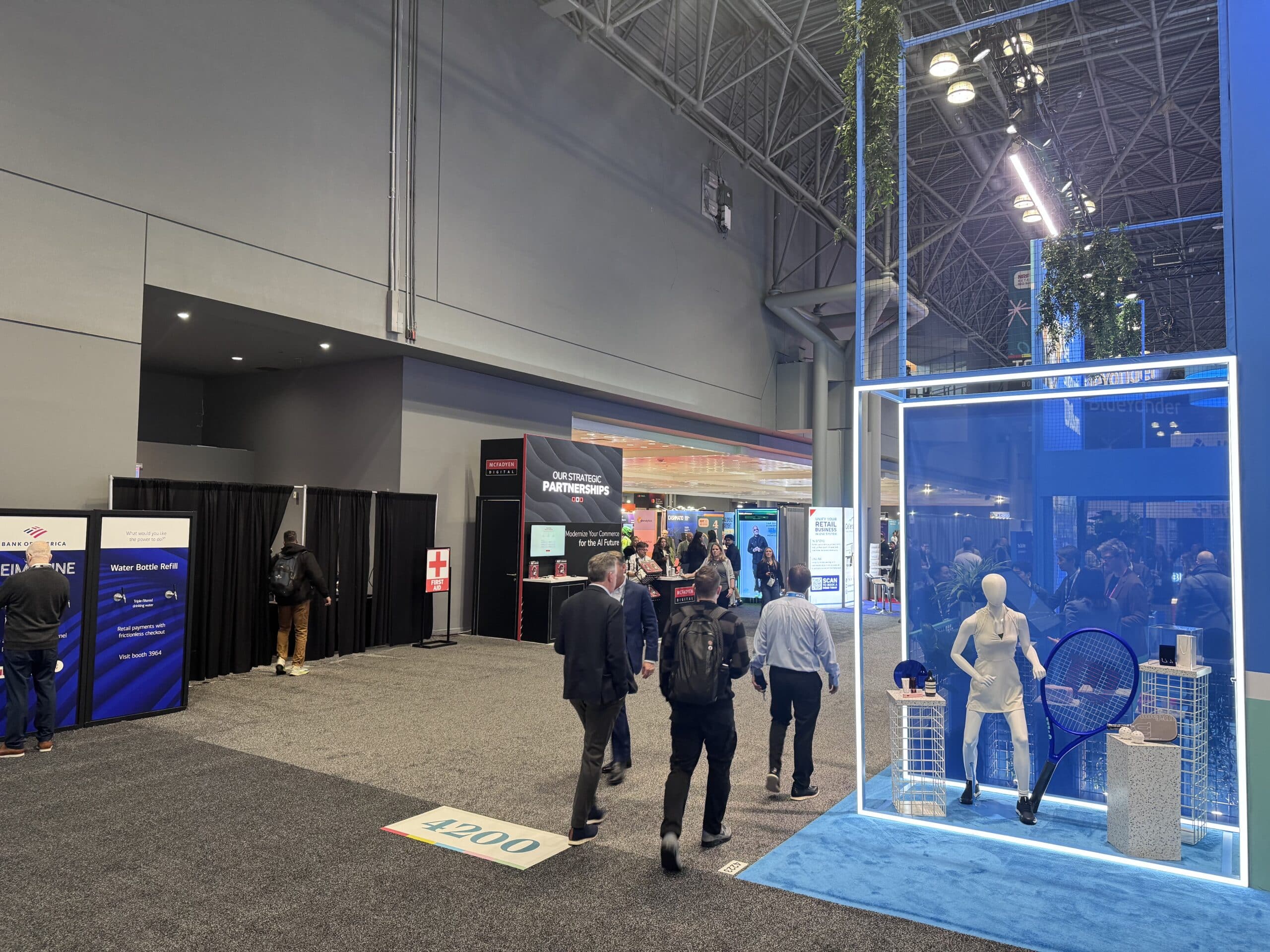
There was a palpable tension at NRF this year. We’ve clearly moved past the ‘chatbot experiment’ phase into real Agentic Commerce—systems that don’t just answer questions, but actually do the work. The tech is finally ready, but the retailers may not be. In conversation after conversation, we heard it loud and clear. Leaders know they can’t stand still, but hardly anyone knows where to start or how to handle the organizational overhaul these systems require. The retail playbook is being rewritten in real time, and frankly, most brands are still trying to figure out how to read it. Here is a breakdown of the major shifts from the show, and why the B2B sector might be beating B2C to the punch
The past few years have produced no shortage of bold predictions about the future of ecommerce and digital marketplaces: agentic AI, fully self-service B2B buying, hyper-personalization, composable everything, and the marketplace imperative as a survival mechanism.
1) The Shift from Conversation to Execution
The most significant takeaway from the floor was the evolution of the AI interface. While 2024 and 2025 focused on “chatting,” 2026 is about “doing.” Every major vendor is now positioning their solutions to support an agentic world where AI doesn’t just suggest a product but manages the entire lifecycle of a transaction. These agents are now capable of negotiating with suppliers, triggering automated replenishment when stock dips, and acting as a true “Personal Shopper” that navigates the checkout process without human intervention.
2) Solving the Discovery Friction: The Universal Catalog Protocol
A massive hurdle for agentic commerce has been the lack of a standardized language between different retail platforms. Google’s announcement regarding the Universal Catalog Protocol (UCP) aims to solve this. By creating a unified standard for how product data is shared and read by AI, the path from a consumer’s intent to an agent’s purchase becomes entirely frictionless. This protocol serves as the “connective tissue” that allows an agent to find, validate, and buy products across the vast web of global commerce.
3) The Rise of the “Optimizer” Standard
The vendor landscape, led by announcements from giants like Google and Shopify, is moving toward “Optimizer” style tools. Shopify’s latest focus on autonomous optimization tools highlights a trend where the platform itself manages the heavy lifting of store performance. Instead of a merchant manually adjusting parameters, agentic tools are now being deployed to handle everything from price elasticity to inventory allocation. This signals the end of the experimentation phase; we are now building a new digital backbone for discovery and shopping
4) Physical Stores as Intelligent Hubs
Agentic commerce isn’t restricted to the digital shelf but bringing it to the physical world requires a tight convergence of hardware and software. NRF 2026 showcased “Intelligence Loops” where the physical infrastructure—smart cameras, shelf sensors, and edge devices—feeds real-time data directly to software agents. By pairing this sensory hardware with proactive Store Operation Agents, physical locations are evolving from reactive spaces into proactive environments. When a vision system identifies a shelf gap, the agent doesn’t just alert a human; it triggers a robotic logistical sequence that reaches back into the supply chain, ensuring the “out of stock” era becomes a relic of the past.
5) The 12-Month Countdown for B2B
While B2C is currently setting the high-speed stage for autonomous commerce, B2B is arguably the superior use case. Historically, the industry has watched B2B trail consumer trends by years, but the patterns established at NRF 2026 suggest this gap is collapsing. The inherent complexity of B2B—with its heavy focus on routine replenishment, complex procurement rules, and dynamic contract negotiations—makes it the perfect environment for AI agents to solve friction that human buyers struggle with. Industry experts now predict that the autonomous shopping behaviors emerging in retail will accelerate into the B2B space, becoming a standard for professional procurement within the next 12 months.
6) Building the Data Backbone
Autonomous agents are only as good as the data they consume. A recurring theme at NRF was that data deficiencies are the single biggest failure point for AI initiatives, leading many vendors to mandate comprehensive data readiness assessments before a project can even launch. To avoid this bottleneck, brands must evolve beyond static specifications to create “AI-friendly” data—enriching records with natural language descriptions, clear use cases, and compatibility logic that machines can easily reason with. You must invest in this deep, structured data and adopt protocols like the Universal Catalog to ensure your products are not just visible, but truly “discoverable” and purchasable by the next generation of AI shoppers.
The Playbook
1. Structure for Machine Discovery. Invest in “AI-friendly” structured data and adopt protocols like the Universal Catalog to ensure your products are legible and discoverable to the next generation of algorithmic buyers.
2. Map the “Action” Journey. Shift from designing for human “clicks” to defining agent “goals,” identifying specific friction points—like reordering or scheduling—that can be fully delegated to autonomous execution.
3. Unify the Digital Ecosystem. Breakdown silos between your commerce, OMS and ERP platforms to create a real-time “intelligence loop,” ensuring agents have the total system visibility needed to solve problems proactively.
4. Target Complexity First. Leverage the “B2B Advantage” by deploying agents against high-friction workflows—such as contract negotiation and complex procurement—where autonomous logic delivers the highest immediate ROI.
Ready to turn the complexity of agentic commerce into your competitive advantage?
Let’s talk: marketing@mcfadyen.com — or ask for a no-cost assessment of your current digital commerce strategy.
Related Articles

Turn Insight Into Impact.
Start Today.