
Written by: Fred Faulkner
Reading time: 6 minutes

Updated: 03/25/2026
Published: 03/26/2026
Here’s a number that should stop you cold: 61% of B2B buyers are already using AI in purchasing decisions. That’s not a projection. That’s today, according to Deloitte’s February 2026 research across 530 suppliers and 530 buyers.
Now here’s the uncomfortable part: only 45% of suppliers are using AI on the selling side. Buyers are ahead of you. And in a world where purchasing decisions are increasingly shaped by the tools buyers use before they ever contact a sales rep, that gap matters more than most commerce teams realize.
What the adoption numbers don’t show is a deeper trust problem.
The Data Says One Thing. Buyers Experience Something Else.
Deloitte’s research turned up a telling disconnect. When asked to rate how automated and easy their sales processes are, 72% of suppliers said “mostly or highly automated.” Only 47% of buyers agreed. Buyers were six times more likely than suppliers to say purchasing processes remain mostly manual — and three times more likely to describe their suppliers as difficult to do business with.
That’s not a small rounding error. That’s a fundamental misalignment between what distribution and manufacturing companies think they’re delivering digitally and what their customers are actually experiencing.
“Our experience with their website has not been good. It is not easy to navigate and consumes a lot of time, even for regular customers.”
These aren’t fringe complaints. They’re consistent enough to call them a baseline.
The Chatbot Problem Nobody Wants To Talk About
Add AI assistants and chatbots into this picture and the trust problem gets sharper. In a high-stakes manufacturing or distribution purchase — where the wrong part number can halt a production line — an AI tool that surfaces inaccurate information isn’t just a UX problem. It’s a revenue risk.
Forrester research reinforces the point: 29% of AI decision-makers identify trust as the single largest barrier to generative AI adoption, ranking it above cost and complexity.
The question every commerce leader should be asking right now isn’t “Should we deploy AI?” Most of you already have. The question is: why aren’t buyers using it?
The Data Problem Underneath The Trust Problem
The trust problem in B2B AI isn’t primarily a technology problem. There are tens of thousands of solutions in the market and more being added every week. What’s driving the trust gap ultimately comes down to data — and the numbers are consistent enough to take seriously.
Only one in four manufacturing operations leaders say they fully trust their data. Eighty-six percent spend more than 30% of their time manually correcting, validating, or interpreting information that should be clean and reliable (Stibo Systems, Manufacturing Dive). Nearly 70% of manufacturers cite data quality, contextualization, and validation as their most significant obstacle to AI implementation, according to Deloitte’s 2025 Manufacturing Trends research.
The consequence is direct: AI built on unreliable data produces unreliable outputs. An AI that surfaces inaccurate product specifications, wrong pricing, or outdated inventory doesn’t just frustrate buyers — it actively erodes confidence in your digital platform as a whole.
Fivetran research found that nearly half of companies delayed, underperformed, or outright failed AI projects despite major investment, with poor data governance as the primary culprit. When customer data lives in one system, order data in another, and product data in a third with no integration between them, AI can’t form an accurate picture of anything — and buyers feel it immediately.
What “AI-Ready Data” Actually Means: The Five C’s
Understanding what AI-ready data looks like in practice is the most useful starting point for any commerce leader trying to close this gap. After working with distributors and manufacturers across dozens of commerce implementations, we’ve identified five properties that data needs to have before AI can use it reliably. We call them the Five C’s.
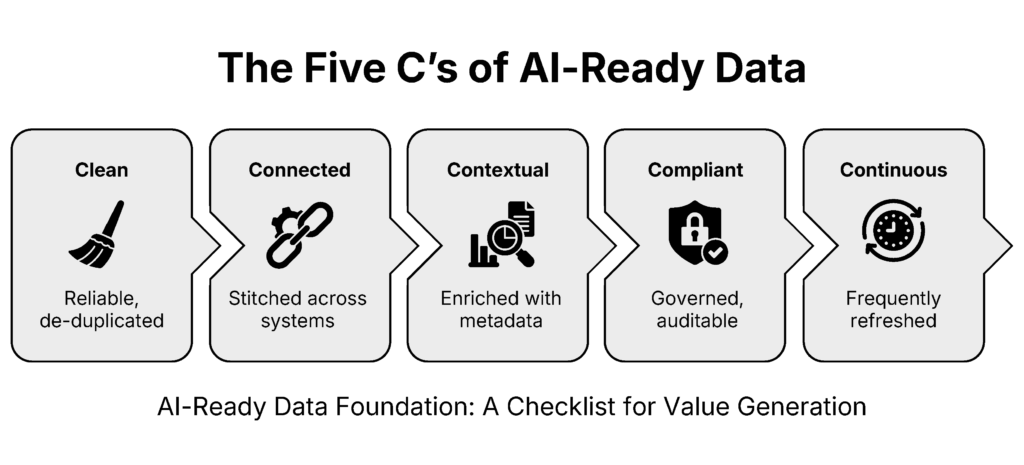
| Clean | Connected | Contextual | Compliant | Continuous |
|---|---|---|---|---|
| Reliable, de-duplicated | Stitched across systems | Enriched with metadata & context | Governed, auditable | Frequently refreshed |
| Fit-for-purpose, de-duplicated data. Especially critical when merging internal and external inputs. A product record that exists in three systems with three different descriptions will produce three different AI answers. | Linked across systems so first-party context follows the customer, product, and order. When customer data lives in one system, order data in another, and product data in a third, AI can’t form an accurate picture of anything. | Enriched with meaning — metadata, semantics, external signals — so models understand what numbers represent. A price without context (currency, tier, date) is noise. A price with context is a signal. | Privacy-safe, governed, and auditable. Trust by design, not afterthought. For commerce leaders, this means consent management, access controls, and data lineage that you can defend to a customer or a regulator. | Refreshed often enough that models track reality, not history. Stale inventory data produces wrong availability answers. Real-time pricing data enables real-time recommendations. Freshness is a competitive variable. |
Perfection is not required on day one — and waiting for it is one of the most common mistakes we see. Visible progress across these five traits matters more than getting any single one to 100%. Each step forward improves model performance and shortens time-to-impact.
The companies making real progress aren’t treating data cleanup as a prerequisite to AI. They’re running both workstreams in parallel — improving data quality while building AI capabilities simultaneously. The organizations that wait for “perfect data” are usually still waiting.
Where Does Your Data Stand Today? The Five Levels of Data Maturity
Knowing the Five C’s tells you what to aim for. The data maturity model tells you where you actually are — and what realistic next steps look like from there.
Most distributors and manufacturers we work with sit somewhere between Level 2 and Level 3. That’s not a condemnation — it means the foundation for reliable AI is buildable, but it requires deliberate investment rather than hoping the current stack will eventually sort itself out.
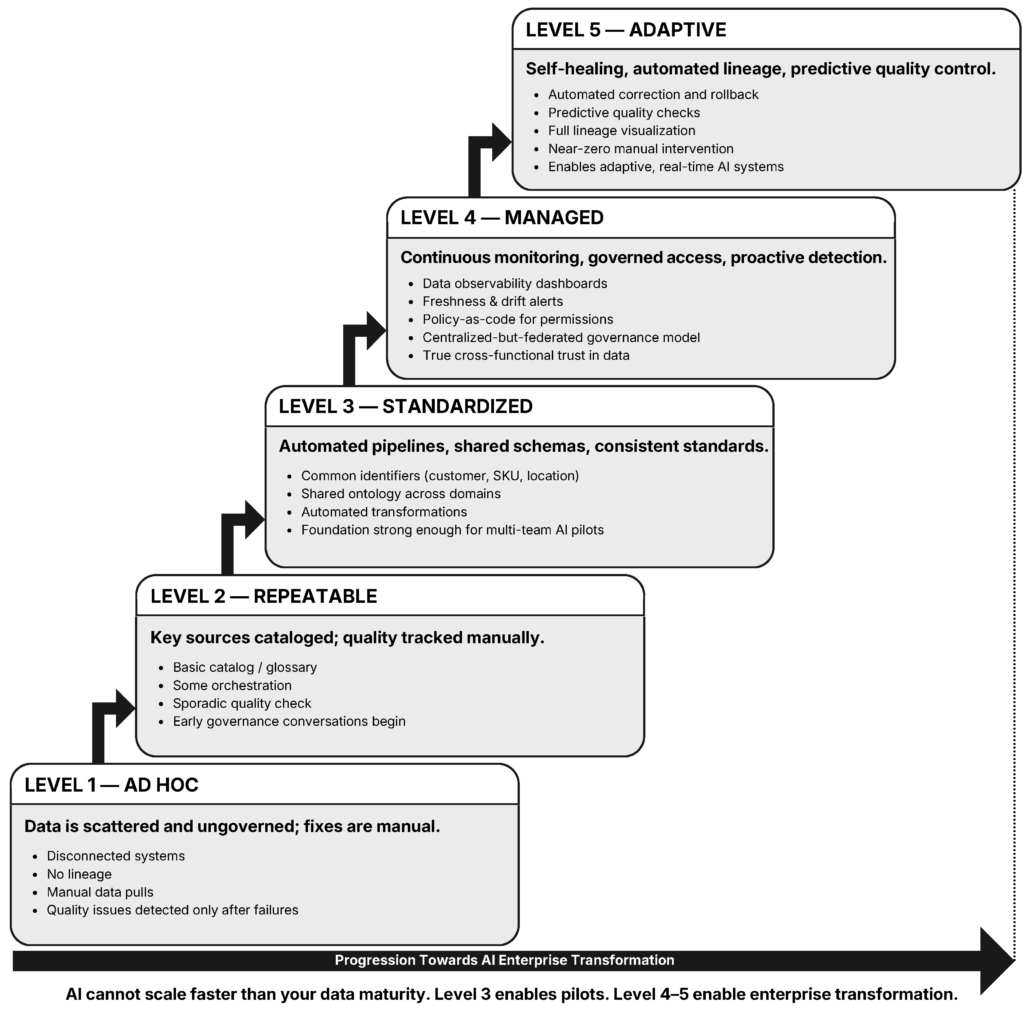
| Maturity | What It Looks Like | AI Readiness |
|---|---|---|
| Level 1 Ad Hoc | Data is scattered and ungoverned. Disconnected systems, no lineage, manual data pulls. Quality issues are only detected after failures — often after a wrong product has shipped or a customer has already complained. | AI is not viable. Any model deployed here will surface errors fast enough to destroy buyer trust. |
| Level 2 Repeatable | Key sources are cataloged; quality is tracked manually. Basic data glossary, some orchestration, sporadic quality checks. Governance conversations have started but are not yet operationalized. | Limited AI pilots possible in isolated areas. Not ready for customer-facing AI features. |
| Level 3 Standardized | Automated pipelines, shared schemas, consistent standards. Common identifiers across customer, SKU, and location. Automated transformations. The foundation is strong enough for multi-team AI pilots. | AI pilots viable. Commerce personalization, product recommendations, and search relevance become realistic with focused effort. |
| Level 4 Managed | Continuous monitoring, governed access, proactive detection. Data observability dashboards, freshness and drift alerts, policy-as-code for permissions. Centralized-but-federated governance model. True cross-functional trust in data. | Enterprise AI transformation enabled. Personalization at scale, real-time recommendations, AI-assisted ordering all become operational. |
| Level 5 Adaptive | Self-healing, automated lineage, predictive quality control. Automated correction and rollback, predictive quality checks, full lineage visualization, near-zero manual intervention. | Enables adaptive, real-time AI systems. The data infrastructure itself becomes a competitive moat. |
The practical takeaway: AI cannot scale faster than your data maturity. Level 3 enables pilots. Levels 4 and 5 enable the kind of enterprise transformation that actually shifts buyer experience — and buyer trust.
[CTA placeholder: Link to full Data Maturity assessment / chapter reference]The Real Cost of The Perception Gap
Deloitte calculated something concrete from all this: suppliers estimate they lose 13% of sales bids due to negative buying experiences. Not due to pricing. Not due to product gaps. Due to friction in the buying process itself.
That number should reframe the conversation in every commerce leadership meeting happening right now. The question isn’t whether you can afford to invest in better digital experiences and cleaner data infrastructure. The question is whether you can afford to keep losing 13 cents of every dollar bid to preventable friction.
Distributors and manufacturers who are closing this gap share a few common traits. They’re not chasing the flashiest AI feature. They’re doing the unsexy foundational work: standardizing product data, integrating disconnected systems, building consistent customer and order records — and then building AI experiences on top of data they can actually defend.
The Question Most Vendors Aren’t Asking
The technology industry has spent two years telling enterprise buyers that AI is the answer. The harder and more valuable question — one most vendors aren’t asking — is: AI built on what?
Buyers are increasingly sophisticated. They’ve seen the demos. They’ve watched the chatbot confidently recommend the wrong product. They’ve experienced the “personalized” recommendation engine that surfaced things they’ve never bought and never will. Their skepticism is earned.
The distributors and manufacturers who pull ahead over the next few years won’t necessarily be the ones who deployed AI fastest. They’ll be the ones who built on a data foundation buyers can actually trust — and then proved it through consistent experience, not marketing claims.
That’s the competitive advantage most of your competitors are leaving on the table right now.
Related Articles

Turn Insight Into Impact.
Start Today.